
Why Industries Trust Mittal Blowers India for Industrial Centrifugal Fan?
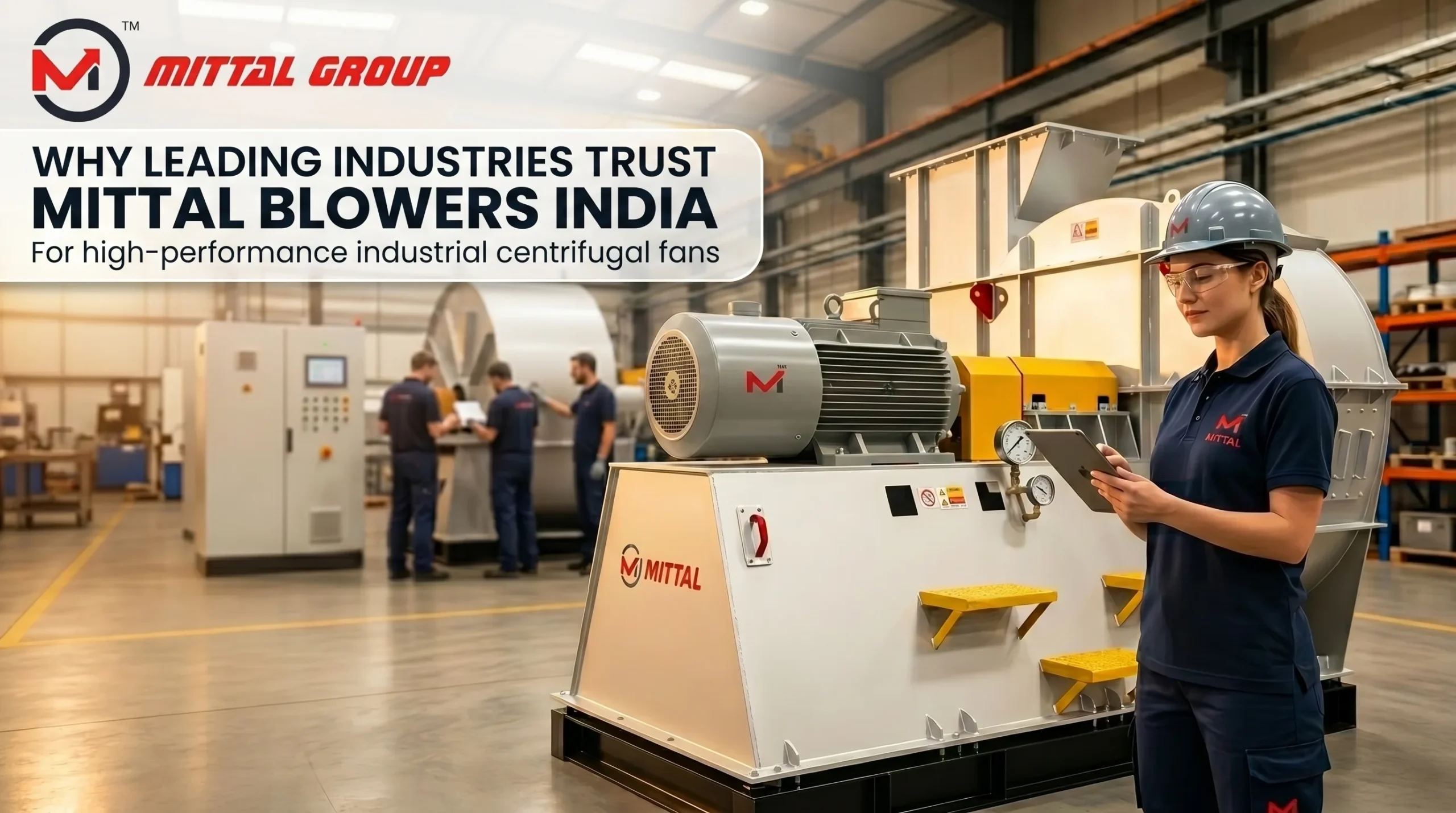
Industrial fans are the lungs of a manufacturing plant – when they fail, everything stops. In power generation, chemical processing, and cement production, air movement systems are essential. They aren’t background equipment; they’re vital for operations. An unplanned shutdown can cost operators tens of thousands of pounds each hour. This includes lost production, damaged materials, and emergency repairs.
That risk is the exact reason plant engineers demand more than off-the-shelf solutions. They need custom centrifugal fans and blowers. These must fit their process conditions, last long, and meet international safety standards.
Mittal Blowers India Pvt Ltd has built its reputation on meeting that demand. Manufacturers build trust in industrial air movement by using exact methods. They keep high standards and ensure compliance worldwide. It’s not something you can take for granted.
The engineering behind that trust starts with the numbers.
Engineering for Extremes: The Technical Thresholds of Mittal Blowers
Understanding why industries trust Mittal Blowers begins with the numbers. Industrial processes don’t allow for comfort. They need equipment made to run at the edge of what is possible, day after day.
Airflow at Scale
Power stations, steel mills, and cement plants need this level of throughput. It helps them keep producing without interruption.
Pressure Performance That Matches the Demand
Static pressures of 1,800 mm H₂O make these units vital for pneumatic conveying systems. Here, material transport relies on strong, steady airstreams. Small pressure issues can block flow, damage parts, or even shut down the whole system.
Speed Range and Specialisation
Operational speeds from 800 to 3,600 RPM help match fan performance to process needs. This range shows a key engineering field. Low-pressure tasks, like ventilation, must use different impeller shapes and motor setups. High-pressure jobs, such as flue gas handling, use other configurations.
Reliable industrial air movement isn’t about power; it’s about performance that is carefully designed for every condition.
Each threshold shows a larger truth. Standard, off-the-shelf solutions often overlook the complexities of big plant environments. That reality makes the case for bespoke centrifugal fan design more challenging to overlook.
Why Custom Centrifugal Fans Are Non-Negotiable for Large Plants
Standard, off-the-shelf fans simply cannot meet the demands of large-scale industrial operations. Industrial fan reliability in large plants hinges on equipment tailored to each facility’s specific needs, not on generic specs meant for the average case.
India’s industrial sector is growing fast. This growth brings more complex air movement challenges. Cement kilns, petrochemical refineries, and steel plants each have unique mixes of temperature, pressure, and gas composition. A single specification mismatch can compromise an entire production line.
Custom centrifugal fans address this through several critical engineering decisions:
Impeller design – blade geometry tailored to specific flow rates and pressure requirements
Material selection – stainless steel, alloys, or coated surfaces for corrosive or high-temperature gas streams
Motor integration – matched drive systems that cut inefficiency at the source
Custom-engineered fans typically reduce energy consumption by 15–25% compared to standard models operating outside their optimal efficiency curve. That saving compounds significantly across years of continuous industrial operation.
However, customization brings its own complexities – and understanding where these solutions have inherent trade-offs is equally important.
Transparency in Engineering: Understanding the Disadvantages of Centrifugal Fans
No piece of industrial equipment is without its limitations and any credible industrial fan manufacturer in India should be upfront about that. Centrifugal fans, for all their power and versatility, carry inherent challenges worth acknowledging.
Key limitations include:
Noise levels that increase sharply at higher operational speeds
Efficiency curves that narrow under variable flow conditions
Surging is when airflow suddenly collapses in high-pressure settings; this can create dangerous instability and may damage equipment.
Surging, in particular, demands serious engineering attention. Poorly matched impeller geometry often causes pulsating pressure. This puts a lot of mechanical stress on the system.
Mittal Blowers tackles these issues with precision, dynamic balancing, and strict TUV-certified tests. This ensures each unit runs stably throughout its entire operating range. Transparency, not just capability, is what earns long-term industrial trust.
This focus on honest engineering brings up a key question: how do formal certifications support that promise?
A Legacy of Compliance: Certifications and Global Social Proof
In an industry where one mechanical failure can halt production and cost millions, certifications are crucial. They show our commitment to quality. For any industrial centrifugal fan to earn a place in a world-class facility, the manufacturer behind it must first pass scrutiny that most suppliers cannot withstand.
Mittal Blowers has ISO 9001:2015 certification and the ‘ZED Gold’ certificate. This award comes from India’s Ministry of MSME. It recognises manufacturers with nearly zero defects and low environmental impact. The ZED framework reveals what procurement teams at multinational firms seek: steady quality, not occasional excellence.
Rigorous global procurement standards leave little room for compromise. Clients such as Saudi Aramco, SABIC, Mahindra, and JSW have supply chains with multi-layered vendor qualification processes. Passing these processes requires documented traceability, defined tolerances, and quality systems that have independent verification.
For end-users, these credentials boost operational confidence. They lead to less unplanned downtime, longer service intervals, and clear safety compliance. A certified manufacturing process isn’t simply a badge; it’s a commitment running through every weld, every balance test, and every dispatch.
Choosing a manufacturer with this level of verified trust is, ultimately, the foundation of any long-term production partnership – which is precisely what the next section explores.
Conclusion: Choosing a Partner for the Next Decade of Production
Selecting an industrial centrifugal fan supplier isn’t a transactional decision – it’s a long-term engineering commitment. This article clearly shows that technical capacity, real customisation, and verified compliance aren’t optional; they are the basics for reliable production.
The long-term ROI of choosing a certified manufacturer is substantial. Fewer unplanned shutdowns, lower maintenance overhead, and equipment built to last translate directly into measurable cost savings across a facility’s lifetime.
Mittal Blowers India Pvt. Ltd. brings all of this together – proven engineering expertise, global certifications, and the willingness to conduct custom air movement audits tailored to your specific operational demands.
If you’re looking to optimise your ventilation or air-handling system, the next step is simple: talk to our engineering team. They can show you the precision-built centrifugal fan solutions that really work.
Faqs
Q1. What industries use centrifugal fans?
Centrifugal fans are common in many industries. You’ll find them in power plants, cement factories, and chemical processing units. They are also used in steel and metal industries, pharmaceutical plants, petrochemical refineries, food processing units, foundries, and pneumatic conveying systems. Any industry requiring controlled airflow, ventilation, or gas handling relies on centrifugal fans.
Q2. Why are custom centrifugal fans better than standard ones?
Custom centrifugal fans are designed for your specific needs. They meet exact airflow rates, pressure requirements, gas temperatures, and material types. Unlike standard fans, these reduce energy use by 15–25% and cut efficiency losses. They use customised impeller shapes, suitable materials like stainless steel and alloys, coated surfaces, and matched motor drives.
Q3. What is the lifespan of an industrial centrifugal fan?
With good care, top-notch industrial centrifugal fans can last 10 to 20 years or even longer. Lifespan depends on operating conditions, material quality, dynamic balancing precision, and regular servicing. Fans used in corrosive or high-heat settings might need special materials for longer life.
Q4. What causes surging in centrifugal fans?
Surging in centrifugal fans happens when the operating point is outside the fan’s stable range. This can be due to mismatched impeller geometry, oversized fan selection, low system resistance, or changing load conditions. It causes pulsating pressure, vibration, and mechanical stress. These can harm the fan and the connected system. Precision engineering and correct fan sizing are the primary preventive measures.