
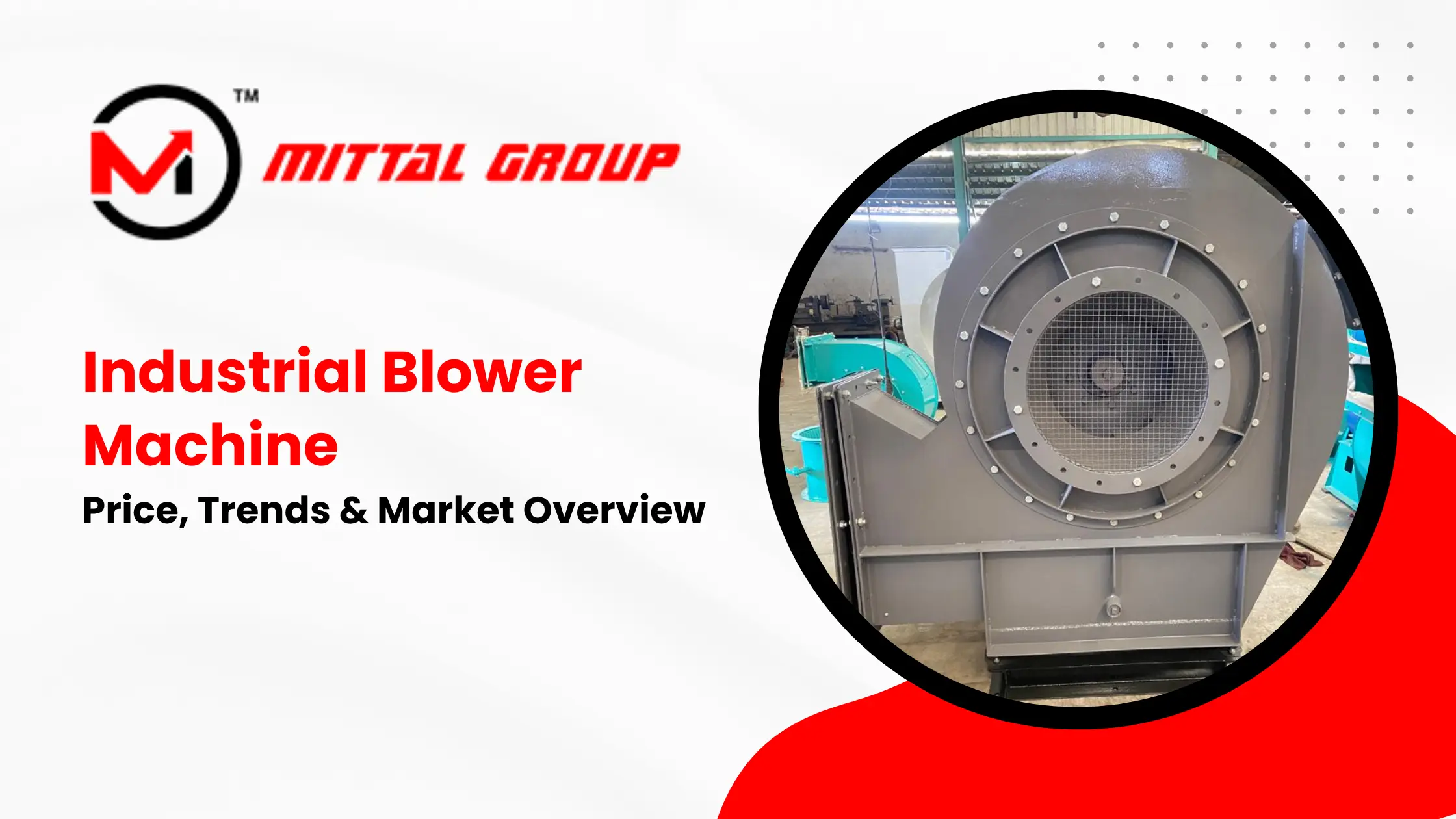
If you have ever tried to get a straight answer on what an industrial blower actually costs in India, you already know the frustration. Supplier catalogues are often outdated, IndiaMART listings give you a price band wider than the Ganga, and most “market reports” hide behind paywalls. This guide cuts through all of that.
We have compiled 2026 price data across blower types centrifugal, ring (regenerative), roots (positive displacement), and axial cross-referenced with current raw material costs, motor price trends, and input from Indian OEM catalogues. Whether you are buying your first blower for an ETP plant or replacing ageing equipment at a cement facility, the numbers and context here will help you benchmark, negotiate, and decide with confidence.
1. Understanding Industrial Blowers Before You Buy
An industrial blower is not just a big fan. It is a precision piece of rotating equipment designed to move large volumes of air or gas at a specific pressure rise and that distinction between a fan, a blower, and a compressor matters enormously when you are comparing prices.
The standard classification by pressure rise is:
| Equipment Type | Pressure Rise | Typical Use Case | Why It Matters for Price |
| Fan | Up to 75 mmWC (735 Pa) | Ventilation, cooling towers | Cheapest category not suitable for process use |
| Blower | 75 mmWC – 1,000 mmWC (0.75 – 10 kPa) | Aeration, conveying, combustion air | Mid-range most industrial buyers are here |
| Compressor | Above 10 kPa | Pneumatic tools, high-pressure gas | Most expensive often overkill for aeration duty |
When an online listing says “industrial air blower ₹12,000” and another says “₹4,50,000”, they are almost certainly describing equipment from different rows of that table. Knowing your required pressure rise (in mmWC or kPa) and flow rate (in m³/hr or CFM) is the single most important step before you evaluate any price.
2. Industrial Blower Machine Price List India 2026
The prices below are ex-works (EXW) indicative rates from Indian manufacturers as of H1 2026. They exclude GST (18% for most blower categories), freight, installation, and alignment charges all of which can add 12–22% to your landed cost.
A. Centrifugal Blower Prices
Centrifugal blowers are the workhorse of Indian industry used in textile mills, cement plants, pharmaceutical units, and municipal water treatment. They handle high flow at moderate pressure and are available in mild steel (MS), stainless steel (SS 304/316), and fibre-reinforced plastic (FRP) for corrosive gas duty.
| Capacity (m³/hr) | Pressure (mmWC) | MOC | Indicative Price (INR, EXW) | Typical Application |
| 300 – 1,000 | 100 – 250 | Mild Steel | ₹15,000 – ₹40,000 | HVAC, small workshops |
| 1,000 – 2,500 | 250 – 500 | MS / SS 304 | ₹40,000 – ₹95,000 | Textile sizing, food processing |
| 2,500 – 6,000 | 500 – 800 | SS 304 / FRP | ₹95,000 – ₹2,80,000 | ETP aeration, pharma |
| 6,000 – 15,000 | 800 – 1,200 | SS 316 / FRP | ₹2,80,000 – ₹6,50,000 | Cement, power plants |
| 15,000+ | 1,200+ | Special alloy / FRP | ₹6,50,000 – ₹15,00,000+ | Large industrial EPC projects |
B. Ring Blower (Regenerative / Side-Channel) Prices
Ring blowers also called regenerative blowers or vortex blowers are compact, oil-free, and nearly maintenance-free. They are the most common choice for aquaculture aeration, small ETP plants, vacuum lifting, and bakery ovens. Because they are largely commoditised, prices are the most competitive in this segment.
| Motor Power (kW) | Max Pressure (mbar) | Max Vacuum (mbar) | Price Range (INR) | Common Use |
| 0.37 | 160 | 120 | ₹8,000 – ₹15,000 | Aquaculture, spa jets |
| 0.75 | 220 | 180 | ₹14,000 – ₹24,000 | Small ETP, bakery |
| 1.5 – 2.2 | 280 – 320 | 230 – 270 | ₹22,000 – ₹45,000 | Vacuum lifting, printing |
| 3.0 – 4.0 | 350 | 300 | ₹42,000 – ₹72,000 | Pneumatic conveying |
| 5.5 – 7.5 | 420 | 360 | ₹68,000 – ₹1,10,000 | Industrial aeration |
| 11 – 15 | 500 | 420 | ₹1,05,000 – ₹1,75,000 | Large ETP, STP |
C. Roots Blower (Positive Displacement) Prices
Roots blowers deliver a consistent, pulsating flow regardless of downstream pressure making them the preferred choice for pneumatic conveying of grains, cement, and fly ash, and for wastewater treatment where a constant air flow into diffusers is critical. They are louder and require more maintenance than ring blowers but offer higher pressure ratios.
| Frame Size (lobe dia.) | Flow Range (m³/min) | Pressure Rise (kPa) | Price Range (INR) |
| 50 – 65 mm | 0.3 – 1.5 | 15 – 40 | ₹28,000 – ₹60,000 |
| 80 mm | 1.5 – 4.0 | 40 – 65 | ₹55,000 – ₹1,10,000 |
| 100 mm | 4.0 – 9.0 | 60 – 80 | ₹1,05,000 – ₹2,20,000 |
| 125 – 150 mm | 9.0 – 20.0 | 80 – 100 | ₹2,10,000 – ₹4,80,000 |
| 200 mm+ | 20.0 – 45.0 | 80 – 100 | ₹4,50,000 – ₹9,00,000 |
D. Axial / Propeller Blower Prices
Axial blowers move air parallel to the shaft axis think of them as large, high-volume, low-pressure movers. They dominate cooling tower and mine ventilation applications where you need to shift massive air volumes against little or no resistance. They are the lowest-cost blower category per m³/hr of flow.
| Impeller Dia. (mm) | Flow Range (m³/hr) | MOC | Price Range (INR) |
| 200 – 400 | 800 – 4,000 | MS / Aluminium | ₹6,000 – ₹22,000 |
| 500 – 800 | 4,000 – 18,000 | MS / FRP | ₹20,000 – ₹65,000 |
| 900 – 1,200 | 18,000 – 55,000 | FRP / SS | ₹60,000 – ₹2,00,000 |
| 1,250 – 1,600 | 55,000 – 1,20,000 | FRP / Special | ₹1,80,000 – ₹6,00,000 |
3. What Actually Drives Industrial Blower Price in India?
Two buyers can ask for a “5 kW centrifugal blower” and receive quotes ranging from ₹45,000 to ₹1,40,000. The difference is not just supplier margin it is engineering. Here is a breakdown of the seven variables that move the price needle:
i. Material of Construction (MOC)
MOC is usually the biggest price lever. A mild steel blower and a stainless steel SS 316 blower of identical capacity can differ by 60–120% in price. Use SS 304 for mildly corrosive gases (lactic acid fumes, mild SO₂); SS 316 for chlorides, seawater, or concentrated acid vapours; FRP for aggressive chemical fumes where even stainless steel corrodes.
ii. Motor Efficiency Class (IE2 vs IE3 vs IE4)
India’s BEE has been progressively mandating higher motor efficiency classes. An IE3 motor costs ₹3,000–₹18,000 more than an IE2 equivalent but saves 4–8% in electricity. On a blower running 6,000 hours/year at 7.5 kW, that efficiency difference pays for itself in under two years. Buyers specifying IE3+ motors are therefore making a financially sound decision even though the upfront price is higher.
iii. Drive Configuration
Direct-coupled (monoblock) blowers are the cheapest and most common. Belt-driven configurations cost ₹4,000–₹15,000 more per unit but allow speed adjustment by changing pulley sizes useful when your process duty point may change. VFD-driven blowers (Variable Frequency Drive) command a 25–45% premium over fixed-speed units but offer the best long-term energy savings for variable-flow applications like ETP aeration.
iv. Impeller Design: Forward-Curved vs. Backward-Curved
Backward-curved (BC) impellers are more expensive to manufacture they require more precise balancing and tighter tolerances but they are more efficient and have a non-overloading power curve. Forward-curved impellers are cheaper but can overload the motor if the system resistance drops unexpectedly. For serious process duty, always specify BC impellers and accept the slight price premium.
v. Inlet / Outlet Connections & Flanges
Blowers supplied with standard MS flanges matching IS/BS/ANSI dimensions are cheapest. Special companion flanges (ASME 150# raised face, for example) or non-standard port orientations (top inlet, bottom outlet) add ₹2,000–₹8,000 and can extend lead time by 2–3 weeks.
vi. Surface Treatment & Special Coatings
A bare MS blower starts corroding in humid environments within months. Epoxy-coated interiors for mild corrosion resistance add ₹3,000–₹6,000. Full rubber lining (for slurry-laden gases) or fluoropolymer coating (for HF or Cl₂ duty) can add ₹15,000–₹60,000 but dramatically extend service life.
vii. Certification Requirements
Standard industrial blowers carry no special certification. If your plant is in a hazardous area (Zone 1 or Zone 2, flammable vapours), you need ATEX-certified or PESO-approved blowers. Certified units cost 35–60% more than standard equivalents but attempting to use an uncertified blower in a hazardous zone is both illegal and dangerous.
4. Price Comparison: Industrial Air Blower vs. Exhaust Blower vs. Turbo Blower
These three terms get conflated constantly in buying searches, yet they describe fundamentally different equipment at very different price points.
| Type | Operating Principle | Pressure Side | Typical Price (5,000 m³/hr) | Best Used For |
| Industrial Air / Pressure Blower | Centrifugal pushes air into process | Positive (discharge) | ₹90,000 – ₹1,60,000 | Combustion air, forced aeration, pneumatic conveying |
| Industrial Exhaust Blower | Centrifugal pulls air away from process | Negative (suction / induced draft) | ₹70,000 – ₹1,30,000 | Fume extraction, dust collection, induced draft fans |
| Turbo Blower (Oil-free) | High-speed centrifugal (20,000–60,000 rpm) | Positive, very high efficiency | ₹4,50,000 – ₹12,00,000 | Large STP/ETP, power plant air slides |
Key insight: An exhaust blower handling clean air costs roughly 15–20% less than an equivalent pressure blower because it operates under suction the casing sees lower net mechanical stress. However, for exhaust blowers handling sticky, high-temperature, or corrosive fumes, factor in special seals and coatings that can equalise or even exceed the pressure blower cost.
5. Industrial Blower Market Overview: India 2026
Where Does India Stand Globally?
The global industrial blower market reached USD 3.9 billion in 2025 and is growing at approximately 5% CAGR through 2035. India accounts for roughly 20% of global volume, positioning it as the third-largest market after China and the United States. India’s domestic market, valued at USD 0.77 billion in 2024, is projected to grow to USD 1.15 billion by 2033 a compound annual growth rate of ~4.5%. This growth is structurally supported, not cyclically driven.
What Is Driving Demand in India?
India’s blower demand story is best understood sector by sector, because the drivers in cement are very different from those in water treatment:
| Sector | Why Blower Demand Is Growing | Preferred Blower Type | 2026 Demand Outlook |
| Water & Wastewater | AMRUT 2.0 500+ cities building/upgrading STPs; NMCG Ganga clean-up program | Roots blower, turbo blower | Strong government-funded |
| Cement & Mining | New cement capacity additions in MP, Rajasthan, Odisha; coal mine ventilation mandates | High-pressure centrifugal, axial | Strong private capex-driven |
| Pharmaceuticals | PLI scheme driving greenfield pharma parks; hygienic blowers for API plants | SS 316 centrifugal, ring blowers | Very strong export-oriented |
| Food Processing | PM SAMPADA cold chain and food parks expansion; bakery & grain conveying | Ring blower, roots blower (food-grade) | Moderate MSME-driven |
| Power (Thermal & Solar) | FGD (Flue Gas Desulphurisation) retrofits on coal plants; large centrifugal for air slides | Large centrifugal, axial ID fans | Moderate regulatory-driven |
| Textiles | New technical textile parks; sizing machine air supply | Backward-curved centrifugal | Moderate capex-dependent |
6. Industrial Blower Price Trends 2026: What Is Changing and Why
Trend 1: Steel Price Volatility Is Moderating – But Not Gone
Hot-rolled coil (HRC) steel prices in India peaked at ~₹60,000/tonne in mid-2024 before correcting. As of H1 2026, they hover around ₹52,000–₹55,000/tonne down from the peak but still ~10% above 2022 levels. This feeds directly into blower casing fabrication costs. Buyers who locked in long-term supply contracts in Q4 2025 are enjoying better rates; spot buyers are paying the current market premium.
Trend 2: The IE3 Motor Transition Is Pushing Up Equipment Costs – Rightfully
BEE’s mandatory IE3 motor notification for motors above 7.5 kW (which came into force for most industrial applications) means that any blower purchased today in that power range will carry an IE3 motor. Compared to an IE2 equivalent, this adds ₹4,000–₹20,000 to the purchase price depending on motor size. This is genuine value creation: a 15 kW IE3 motor saves approximately ₹12,000–₹18,000/year in electricity at 5,500 operating hours the payback is under 18 months in most cases.
Trend 3: Domestic Turbo Blower Manufacturing Is Arriving Finally
Until 2022, virtually all turbo blowers (oil-free, high-speed centrifugal units above 100 kW) used in Indian STPs and power plants were imported from Germany, Japan, or South Korea at a significant forex premium. Two Indian manufacturers backed by PLI scheme incentives have now launched domestically made turbo blowers at 25–35% lower price than imports for the same performance envelope. This is creating price pressure at the top end of the centrifugal blower market and giving Indian STP developers a viable local option for the first time.
Trend 4: Online Procurement Is Compressing Distributor Margins
Platforms like IndiaMART, TradeIndia, and direct OEM portals have fundamentally changed how buyers discover and shortlist blowers. Distributors who previously marked up products 18–25% now face buyers who have already checked the OEM’s website price. The result: standard catalogue blowers (ring blowers under 5 kW, small centrifugal units) are now priced 10–15% lower in real terms than three years ago because the middleman margin has compressed. Custom-engineered blowers, however, still command full margin because the buyer cannot easily compare apples to apples online.
Trend 5: Is Industrial Blower Price Increasing in 2026?
The honest answer is: it depends on the segment. Ring blowers and standard centrifugal blowers under 10 kW are flat to marginally down in price due to competition. Mid-to-large centrifugal and roots blowers are up 5–12% YoY due to steel and motor cost increases. Turbo blowers are down 20–30% as domestic manufacturing alternatives emerge. Specialty blowers (ATEX, food-grade SS 316, special coating) are up 8–15% due to material and certification costs.
Conclusion: What to Take Away
The industrial blower market in India in 2026 is not a buyer’s market or a seller’s market it is a knowledge market. Buyers who arrive with a defined duty point, a clear MOC specification, and a total-cost-of-ownership mindset consistently pay less for better equipment than those who chase the lowest list price.
The structural growth story for India is solid: government water infrastructure spending, pharmaceutical export ambitions, and energy efficiency mandates are all creating genuine, sustained demand for quality blowers. That means reliable Indian manufacturers are investing in better products, and genuine competition at the standard catalogue end is keeping prices honest.
The one thing to avoid: taking a price from this guide (or any guide) as a procurement target without getting a formal quotation to your specific duty point. A 15% variation from guide price is normal and expected. A 50% variation usually means you are comparing different specifications – which is the most useful thing knowing the market can tell you.
Frequently Asked Questions
What is the industrial blower machine price in India in 2026?
Prices span a very wide range: from ₹8,000 for a compact 0.37 kW ring blower to ₹1,50,00,000+ for a large turbo blower package with inlet filtration and silencer. The most purchased segment for process industry applications centrifugal blowers in the 1,000–3,000 m³/hr range costs ₹40,000–₹1,20,000 ex-works from Indian manufacturers. Always add 18% GST and freight when budgeting.
What is the industrial blower price per kg?
Blowers are not sold by weight pricing is by performance (flow rate, pressure, power). However, for fabricated blower casings and impellers ordered as spare parts or as custom fabrications, Indian workshops quote MS fabrication at ₹110–₹160/kg and SS 304 fabrication at ₹220–₹380/kg, excluding machining and finishing. Complete assembled blowers are never priced this way.
Which is the cheapest industrial blower available in India?
The cheapest complete industrial blowers are small ring blowers oil-free, single-phase, 0.37 kW units available from ₹8,000–₹12,000 from manufacturers in Ahmedabad and Delhi NCR. For centrifugal blowers, the entry point is around ₹14,000–₹18,000 for a small MS unit handling 300–500 m³/hr at low pressure. However, “cheapest” for your application is a more useful question than cheapest overall buying underpowered equipment is the most expensive mistake in blower selection.
Is industrial blower price increasing in 2026?
By segment: standard ring blowers and small centrifugal blowers are flat or marginally cheaper due to domestic competition. Mid-to-large centrifugal and roots blowers are 5–12% higher YoY (steel and motor cost increases). Turbo blowers are 20–30% cheaper as domestic manufacturing alternatives have emerged. Specialty and certified blowers (ATEX, food-grade SS 316) are up 8–15%.
What is the difference between industrial air blower price and exhaust blower price?
For the same capacity, an industrial pressure (air supply) blower typically costs 15–25% more than an equivalent exhaust blower in standard materials, because pressure blowers require heavier casing construction to withstand positive pressure. However, exhaust blowers handling corrosive, sticky, or high-temperature fumes require special materials and seals that can eliminate or reverse this cost advantage.