
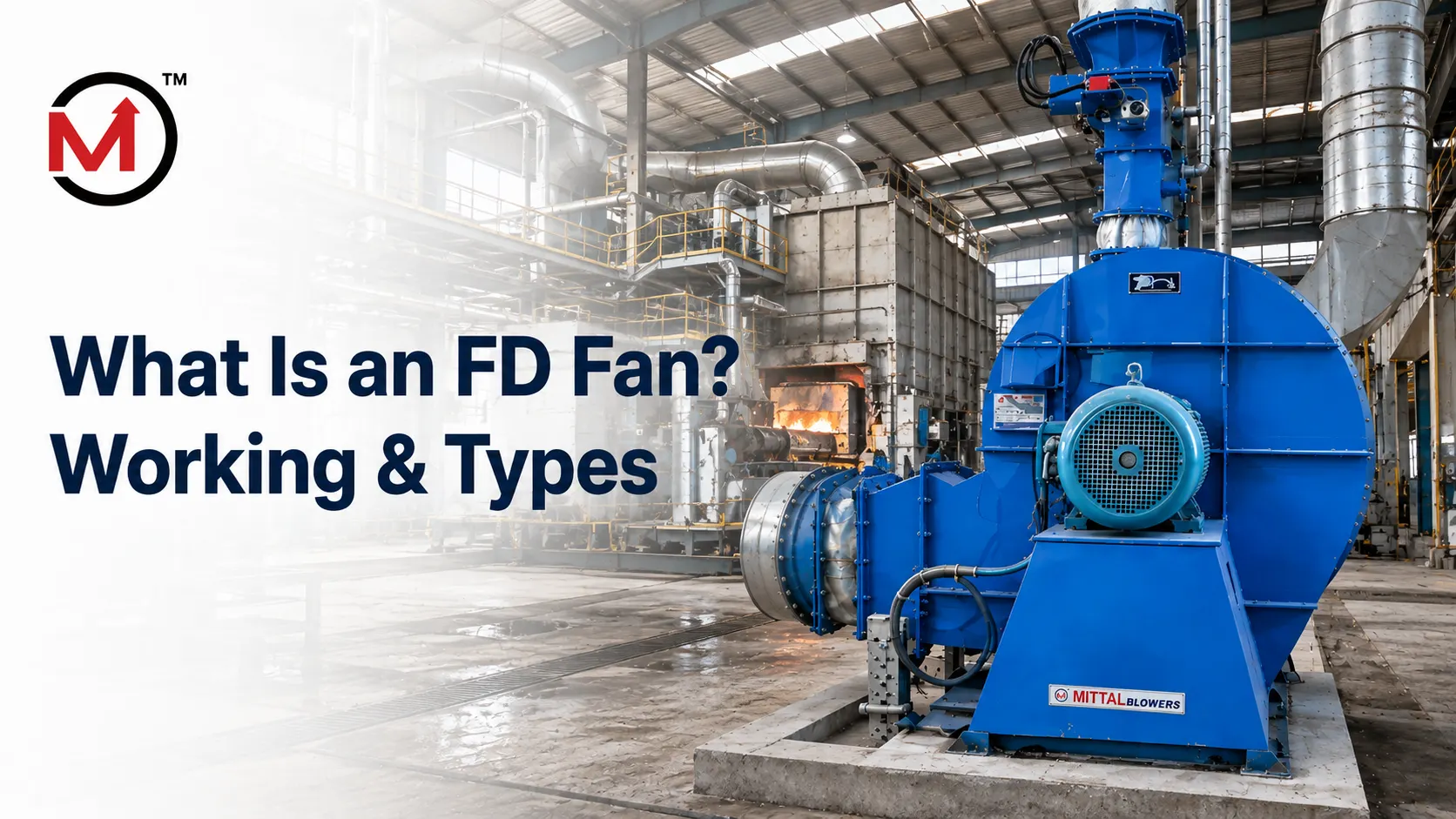
In any boiler or furnace, fuel is only half the story – combustion also needs a steady, controlled supply of air. That air is delivered by a forced draft fan. This guide explains what a forced draft fan is, how it works, its main types and components, where it is used, and the key factors that go into selecting one.
What Is a Forced Draft (FD) Fan?
A forced draft fan is a mechanical fan installed at the air inlet of a boiler or furnace that pushes fresh atmospheric air into the combustion chamber under positive pressure. The term “forced draft” simply means the air is forced (pushed) in, rather than being pulled out. Because the FD fan sits ahead of the combustion zone, it handles clean, cool ambient air. This gives it two big advantages: lower impeller wear and higher operating efficiency compared with fans that handle hot, dust-laden flue gas. Most industrial FD fans are centrifugal, chosen for their ability to deliver a stable air volume against system resistance.
How Does an FD Fan Work?
The working principle is straightforward. An electric motor drives the fan impeller, which draws air in from the atmosphere. As the impeller rotates, it accelerates the air outward; the fan housing then converts that velocity into pressure. This pressurised air is pushed through ducts – often via an air preheater – into the windbox and burners, where it mixes with fuel for combustion.
Because the fan maintains positive pressure on the air side, the combustion air path stays above atmospheric pressure. In a balanced-draft boiler, the FD fan works together with the induced draft fan that pulls hot flue gases out of the system, so the furnace is kept at a slight negative pressure for safe, stable operation.
FD Fan vs ID Fan - Key Difference
The working principle is straightforward. An electric motor drives the fan impeller, which draws air in from the atmosphere. As the impeller rotates, it accelerates the air outward; the fan housing then converts that velocity into pressure. This pressurised air is pushed through ducts – often via an air preheater – into the windbox and burners, where it mixes with fuel for combustion.
Because the fan maintains positive pressure on the air side, the combustion air path stays above atmospheric pressure. In a balanced-draft boiler, the FD fan works together with the induced draft fan that pulls hot flue gases out of the system, so the furnace is kept at a slight negative pressure for safe, stable operation.
This distinction is worth getting right when specifying a boiler, because the point at which you choose between an induced and a forced draft fan affects duct layout, fan material and running cost. Add the primary air fan to the picture and you have the three draft fans a pulverised-coal boiler relies on.
Types of Forced Draft Fans
FD fans are classified mainly by impeller design and construction:
- Backward-curved FD fans – the most common choice, offering high efficiency and stable performance across a wide range of duties.
- Airfoil-blade FD fans – the highest-efficiency option, ideal for large boilers where energy saving matters most.
- Radial-blade FD fans – rugged and tolerant of light dust, used where durability is the priority.
- SWSI vs DWDI – Single Width Single Inlet fans suit standard flows, while Double Width Double Inlet (DWDI) fans handle very high air volumes.
Axial FD fans are also used in some high-flow, low-pressure applications, but centrifugal designs dominate industrial boiler service.
Applications of FD Fans
Forced draft fans are used wherever fuel is burned and controlled combustion air is required:
Boilers & Thermal Power Plants
This is the classic FD fan application – supplying combustion air to coal, oil, gas and biomass boilers. In pulverised-coal boilers the FD fan supplies the bulk of the combustion air, while the primary air fan that carries pulverised fuel into the furnace handles fuel transport.
Cement, Steel & Process Industries
FD fans feed combustion air to cement kilns, steel reheating furnaces, foundry cupolas, glass tanks and ceramic kilns. In sugar, paper and chemical plants they support process boilers and dryers. With India expanding its biomass and waste-to-energy capacity, FD fans (paired with ID fans) are increasingly specified for renewable-fuel boilers.
Main Components of an FD Fan
- Impeller / fan wheel – generates air flow and pressure.
- Housing / casing – converts velocity into usable static pressure.
- Shaft & bearings – support and transmit rotation smoothly.
- Drive motor – powers the impeller, often with a VFD for control.
- Inlet damper or guide vanes – regulate air flow to match combustion demand.
How to Select the Right FD Fan (CFM & Static Pressure)
Choosing an FD fan is about matching the fan to the combustion system. The key parameters are:
- Air flow (CFM / m³/hr) – derived from the fuel firing rate and the excess air needed for complete combustion.
- Static pressure – the total resistance of ducts, air preheater, windbox and burners the fan must overcome.
- Air temperature & altitude – both change air density and therefore fan sizing.
- Construction & control – material of construction, motor rating, and damper vs VFD control for efficiency.
Getting these numbers right avoids an oversized fan that wastes power or an undersized fan that starves the flame.
FD Fan Maintenance Tips
- Monitor bearing temperature and vibration regularly to catch problems early.
- Keep the impeller clean and periodically check its dynamic balance.
- Lubricate bearings and verify shaft-to-motor alignment on schedule.
- Inspect dampers, guide vanes and duct joints for leaks or sticking.
Choosing an FD Fan for Your Plant
A forced draft fan is always matched to a specific combustion system rather than picked off a shelf, so the fuel type, firing rate and duct layout decide the correct air flow and static pressure. Mittal Blowers manufactures FD fans and other centrifugal fans and blowers in Ahmedabad for boiler and furnace applications.