
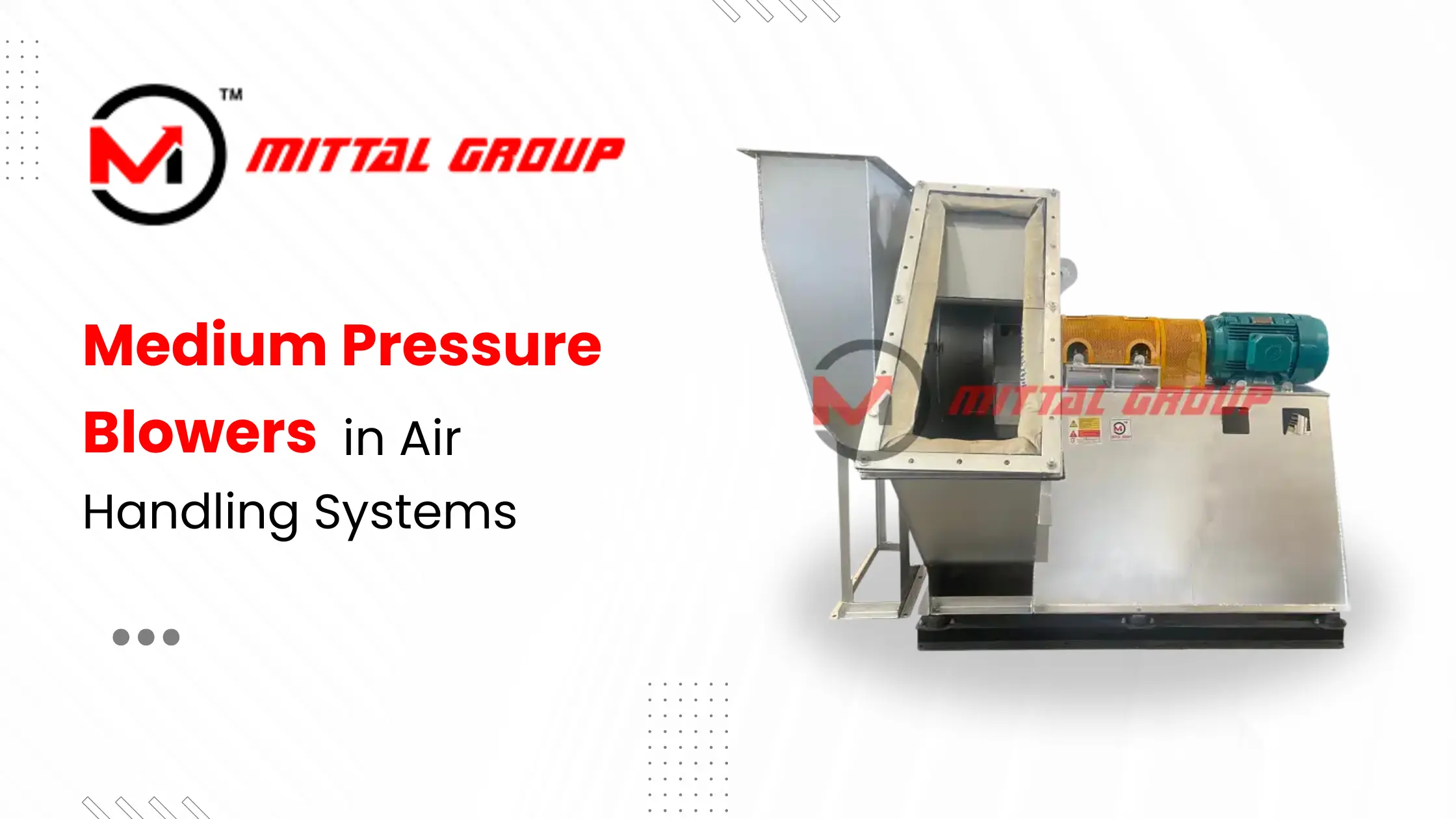
In today’s competitive industrial environment, air handling is one of the most critical aspects of plant operations. Medium pressure blowers are mechanical devices engineered to move large volumes of air or gas at pressure ranges typically between 500 mmWC to 3000 mmWC. They are specifically designed for applications that demand sustained airflow with moderate to high static pressure conditions that standard fans or low-pressure blowers are simply unable to meet. A trusted industrial Medium Pressure blower machine manufacturer designs these units to handle a variety of gases, dust-laden air, and high-temperature environments, making them extremely versatile across a wide range of industries.
The working principle of medium pressure blowers depends on centrifugal action or positive displacement. Fresh ambient air or process air enters the blower through a silencer or duct where the high-speed spinning impeller creates kinetic energy in the entering air. The volute casing subsequently changes the velocity of the air into static pressure, propelling the air within the system with sufficient pressure. After that, the pressurized air moves out from the outlet section of the blower and is discharged to ductwork, nozzles, or downstream process equipment. Due to this highly efficient design, medium pressure blowers can work steadily under varying conditions.
When sourced from the reliable medium pressure blower machine manufacturing company, these blowers are fitted with many sophisticated technologies that distinguish them from ordinary blowers. They have the ability to operate within a higher static pressure range between 500 mmWC to 3000 mmWC, and they are made using strong material choices such as Mild Steel, SS304, SS316, FRP, and Cast Iron to withstand corrosive conditions or abrasive environments. Depending on the amount of space required or the power of the blower required, you can go for either direct drive or belt drive types. The temperature resistant models can handle hot gases, and special impeller designs may be customized for specific processes.
The industrial sector demands different blower designs for different process conditions, and a reliable industrial Medium Pressure blower machine manufacturer typically offers a complete range to address this diversity. Centrifugal blowers are the most widely used type and are best suited for high-volume airflow with steady pressure, making them ideal for ventilation, combustion air supply, and drying systems. Radial blowers are specifically designed for dust-laden or abrasive air streams and find extensive use in pneumatic conveying and material handling applications. Backward curved blowers are the energy-efficient choice for clean air applications such as HVAC systems and air filtration units. Forward curved blowers are compact and cost-effective, catering to general ventilation and light industrial duties. For applications requiring exceptionally high pressure without the complexity of full high-pressure machinery, multi-stage blowers are used to build up pressure progressively across multiple stages.
Industrial air handling is far more demanding than standard commercial HVAC applications. Plant engineers face challenges including high dust loads, corrosive fumes, elevated temperatures, round-the-clock continuous operation, and the need for precise pressure control at all times. Medium pressure blowers are uniquely equipped to address all of these challenges simultaneously. They deliver consistent airflow regardless of system resistance changes, which is critical for processes like combustion, drying, and cooling. In sensitive industries like pharmaceuticals and food processing, maintaining controlled air pressure prevents contamination and ensures product quality. These blowers are also central to fume extraction and scrubbing systems, helping industries stay compliant with environmental emission norms. Additionally, compared to high-pressure alternatives, medium pressure blowers consume significantly less power for the same output, directly reducing the plant’s operational energy costs. Proper air pressure management also prevents overheating of connected machinery and prolongs overall equipment life.
Parameter | Low Pressure Blowers | Medium Pressure Blowers | High Pressure Blowers |
Pressure Range | Below 500 mmWC | 500 – 3000 mmWC | Above 3000 mmWC |
Category | Light-duty | Industrial workhorse | Heavy-duty / Specialized |
Typical Applications | Light ventilation, simple air movement | Air handling, pneumatic conveying, combustion, process applications | High-resistance, specialized applications |
Industrial Suitability | Not adequate for industrial process demands | Suitable for most industrial applications | Reserved for very specific applications |
Energy Cost | Low | Optimal / Balanced | Significantly higher |
Mechanical Complexity | Simple | Moderate | Complex |
Pressure-to-Energy Ratio | Limited capability | Optimal | Lower efficiency at standard tasks |
Best For | Basic ventilation tasks | Majority of industrial air handling systems | High-resistance specialty needs |
Preferred By | Limited industrial use | Plant engineers, project consultants, procurement teams | Niche/specialized industries only |
Energy costs in industrial plants can be substantial, and blower systems often contribute a significant share to the total electricity consumption. A well-designed medium pressure blower from a quality industrial Medium Pressure blower machine manufacturer helps address this concern on multiple fronts. Aerodynamically optimised impellers minimise slip losses and maximise air delivery per kilowatt of input power. Most modern units are compatible with Variable Frequency Drives, allowing precise flow rate modulation without wasting energy during low-demand periods. Dynamically balanced impellers reduce vibration-induced power losses, while sealed bearing systems minimise friction losses and improve overall mechanical efficiency. For hot-gas handling applications, insulated casing options reduce heat loss and contribute to better thermal efficiency. Together, these features can result in energy savings of 20 to 40 percent compared to older or lower-quality blower systems.
Selecting the correct medium pressure blower is a technical decision that requires careful evaluation of multiple process parameters. The required airflow volume in cubic metres per hour or CFM, and the system static pressure in mmWC or Pascals, form the foundation of the selection process. The type of gas or air being handled whether clean, dusty, corrosive, or at elevated temperatures directly influences the material of construction and impeller design. Available motor power, voltage specifications, space constraints, and installation orientation all need to be considered before finalising a model. Noise and vibration requirements, as well as applicable regulatory and safety standards such as ATEX, IS, or CE certifications, must also be factored in. A detailed process data sheet shared with your industrial Medium Pressure blower machine manufacturer ensures the blower is precisely engineered to your specifications, preventing the risks of under-performance, premature wear, or energy wastage due to incorrect sizing.
Industrial air handling comes with a unique set of operational challenges, and medium pressure blowers are specifically engineered to overcome them. Inconsistent airflow that affects product quality is addressed by blowers with backward-curved impellers, which provide non-overloading characteristics and maintain stable pressure across variable flow conditions. High dust concentration causing rapid impeller wear is tackled through the use of heavy-duty radial tip impellers with wear-resistant coatings or hard-facing that withstand abrasive environments over long service periods. Corrosive fumes that damage internal components are countered by offering FRP or SS316 constructions with chemical-resistant coatings, ensuring long and reliable service life. High energy bills from continuous blower operation are significantly reduced through VFD-compatible motors and optimised aerodynamic design. Noise and vibration that disturbs nearby operations or personnel is controlled through anti-vibration mounts, acoustic enclosures, and precision dynamic balancing techniques employed by experienced manufacturers.
Proper maintenance is the single most effective way to maximise blower life and minimise costly unplanned downtime. Inlet filters must be inspected and cleaned or replaced regularly to prevent pressure drop across the system, which can reduce both performance and energy efficiency. Bearings should be lubricated strictly as per the original equipment manufacturer’s schedule, as both over-lubrication and under-lubrication are equally harmful. Vibration levels should be monitored monthly using a vibration analyser to detect early signs of imbalance or bearing wear before they develop into serious failures. In belt-driven units, belt tension and alignment should be checked on a quarterly basis to prevent power transmission losses. The impeller should be periodically inspected for signs of wear, corrosion, or dust build-up that may cause operational imbalance. Coupling alignment must be verified in direct-drive configurations, and all inlet and outlet duct connections should be checked for air leaks that can reduce system efficiency. Maintaining a log of key operating parameters such as pressure, temperature, and motor current helps identify gradual performance degradation trends before they become critical issues.
The medium pressure blower industry is undergoing significant technological transformation, driven by the broader push toward industrial digitisation and sustainability. IoT-enabled monitoring systems are being integrated into blower units, providing plant operators with real-time performance data and enabling predictive maintenance strategies that dramatically reduce unplanned downtime. Magnetic bearing technology is emerging as a game-changer, eliminating the need for oil-based lubrication entirely and reducing maintenance requirements to near zero. Advances in additive manufacturing are enabling 3D-printed impellers with complex aerodynamic geometries that were previously impossible to machine, resulting in measurable efficiency improvements. Permanent magnet motors are gradually replacing traditional induction motors, delivering an additional 5 to 15 percent in energy savings due to their superior power factor and efficiency characteristics. Leading industrial Medium Pressure blower machine manufacturers are also adopting sustainable production processes, eco-friendly materials, and circular economy principles in their manufacturing operations, aligning their products with the global green industrial agenda.
Connect with Mittal Blowers India Pvt Ltd. for energy-efficient, durable, and customized air handling solutions.
Medium pressure blowers are far more than simple mechanical components they are the backbone of reliable, efficient, and safe industrial air handling systems worldwide. From supplying combustion air in furnaces and kilns, to exhausting toxic fumes from chemical reactors, from driving pneumatic conveying lines to maintaining precise cooling airflow over sensitive equipment, these machines work continuously in the background to keep industrial plants operating at peak performance.Partnering with the right industrial Medium Pressure blower machine manufacturer ensures that you receive not just a product off the shelf, but a complete engineered solution one that is backed by deep application expertise, rigorous quality manufacturing standards, and dependable long-term after-sales support. The right blower, correctly specified and properly maintained, will reward your facility with years of trouble-free, energy-efficient, and safe operation that directly contributes to your bottom line.
A medium pressure blower is an industrial air-moving device designed to deliver airflow at pressure ranges between 500 mmWC to 3000 mmWC for applications like ventilation, combustion, cooling, and pneumatic conveying.
Medium pressure blowers are widely used in industries such as cement, pharmaceuticals, food processing, chemical plants, textile, foundries, wastewater treatment, and HVAC systems.
Low pressure blowers are used for simple ventilation applications below 500 mmWC, while medium pressure blowers provide higher airflow pressure suitable for demanding industrial processes.
Yes, modern medium pressure blowers are designed with aerodynamic impellers, VFD compatibility, and balanced rotating components that help reduce power consumption and improve efficiency.