
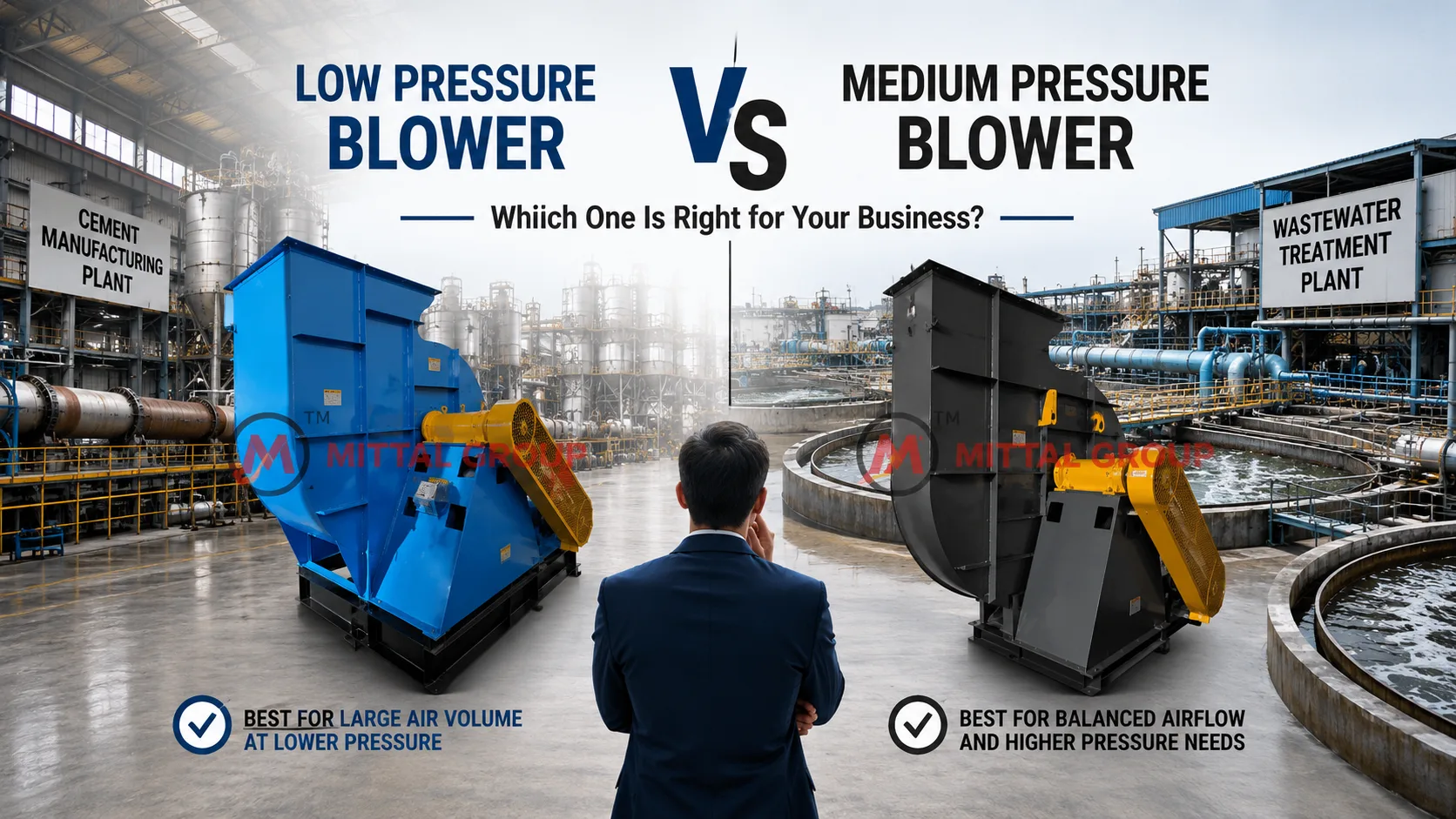
Choosing the wrong blower can quietly drain your energy budget, underperform in your process, or wear out years too early. That is why the low pressure blower vs medium pressure blower decision matters so much for any facility that moves air. Both machines push air, but they are built for different resistance levels, applications, and pressure ranges. In this guide, we break down the difference between low and medium pressure blowers in plain language – working pressures, applications, energy efficiency, noise, and cost – so you can confidently match the right blower to your system and avoid an expensive mismatch.
If you already know your system’s airflow (CFM/CMH) and the resistance it has to overcome (static pressure), you can skip to the comparison table and the selection section below. If not, start here – the fundamentals will save you from guessing.
What Is a Low Pressure Blower?
A low pressure blower is designed to move large volumes of air against very little resistance. Think of a system with short, wide ducts or open discharge, where air just needs to keep moving rather than be forced through narrow, restrictive paths. Low pressure blowers prioritise volume over pressure, which makes them efficient, quieter, and cheaper to run for the right jobs.
In centrifugal form, a low pressure centrifugal blower typically uses a forward-curved or lightly loaded impeller that spins air outward with modest pressure gain. These are common wherever gentle, high-volume airflow is enough to get the job done.
Low Pressure Blower Working Pressures
So what pressure range is considered low pressure for blowers? In practice, low pressure blowers operate up to roughly 0.15 bar (about 1,500 mmWC or 60 inches of water column). Below this level, the machine can deliver strong airflow without working hard to build static pressure – which is exactly why it stays efficient and cool. Exact thresholds vary slightly by manufacturer, so always check the blower’s performance curve against your system requirement.
Low Pressure Blower Applications
Low pressure blower applications are everywhere in commercial and light-industrial settings. Typical uses include:
- General ventilation & HVAC – air handling in HVAC systems, fresh-air supply, and general room ventilation
- Cooling – cooling of machinery, electronics, and production lines
- Drying – surface drying, air knives, and moisture removal
- Combustion air – combustion air supply for burners and small furnaces
- Exhaust & extraction – low-resistance fume and odour extraction in open areas
What Is a Medium Pressure Blower?
A medium pressure blower is built to push air through more resistance – longer ducting, filters, diffusers, or a column of liquid – while still delivering a useful volume of air. It sits between low pressure blowers (high volume, low resistance) and high pressure blowers or compressors (low volume, high resistance). Medium pressure centrifugal blowers usually use backward-curved impellers and a sturdier build to generate and sustain that extra pressure without overloading the motor.
Medium Pressure Blower Working Pressures
What pressure range is considered medium pressure for blowers? Medium pressure blowers generally work in the range of roughly 0.15 to 0.5 bar (about 1,500–5,000 mmWC or 60–200 inches of water column). This higher operating band lets them overcome the resistance of ducts, aeration tanks, and dust-collection filters that would stall a low pressure unit. As always, confirm the exact figures on the manufacturer’s curve for your model.
Medium Pressure Blower Applications
Medium pressure blower applications tend to be more demanding, resistance-heavy processes, such as:
- Ducted systems – supplying air to ducted HVAC and process ventilation with filters and long runs
- Wastewater aeration – diffused aeration in wastewater and effluent treatment plants
- Dust collection – filter-based dust collection and heavier fume extraction
- Pneumatic conveying – light-duty pneumatic conveying of powders and granules over short distances
- Industrial processes – process air for drying towers, kilns, and material handling
Low Pressure Blower vs Medium Pressure Blower: Key Differences
Parameter | Low Pressure Blower | Medium Pressure Blower |
Typical working pressure | Up to ~0.15 bar (up to ~1,500 mmWC / ~60 in. WC) | ~0.15–0.5 bar (~1,500–5,000 mmWC / ~60–200 in. WC) |
Airflow character | High volume, low resistance | Moderate volume, higher resistance |
Best for | Open or short-duct ventilation, cooling, drying | Ducted systems, aeration, light conveying |
Energy use per CFM | Lower (less work per unit air) | Higher (more work to build pressure) |
Noise level | Generally lower | Generally higher at the same size |
Impeller / design | Often forward-curved or axial style | Backward-curved / heavier build |
Typical cost | Lower upfront and running cost | Higher upfront and running cost |
Difference Between Low and Medium Pressure Blowers
The core difference between low and medium pressure blowers comes down to how much resistance the air has to overcome. A low pressure blower moves a lot of air but gives up quickly when resistance rises. A medium pressure blower moves somewhat less air but keeps pushing against ducts, filters, and back-pressure that would choke a low pressure unit.
Put simply: low pressure equals high volume, low resistance; medium pressure equals moderate volume, higher resistance. Matching this profile to your system is the single most important step in blower selection.
Low Pressure vs Medium Pressure Centrifugal Blowers
When comparing low pressure vs medium pressure centrifugal blowers specifically, the biggest differences are in the impeller and construction. Low pressure centrifugal blowers favour forward-curved blades for high airflow at low pressure, while medium pressure centrifugal blowers use backward-curved blades and heavier housings to build and hold higher static pressure. The result: medium pressure units are more robust and versatile for ducted and process work, but they cost more and draw more power to do it.
Low Pressure vs Medium Pressure Blower: Energy Efficiency
Energy efficiency is where the wrong choice hurts your bottom line month after month. A low pressure blower does less work per unit of air, so for low-resistance jobs it is almost always the more energy-efficient option. Oversizing to a medium pressure blower for a low-resistance system wastes electricity because the machine is capable of far more pressure than the system needs.
However, the opposite is also true: forcing a low pressure blower to serve a high-resistance system makes it run inefficiently, overheat, and consume more power while still underperforming. The most efficient blower is the one whose performance curve matches your system’s operating point – not simply the smallest or the largest machine.
Low Pressure vs Medium Pressure Blower: Noise Level
Noise level often follows pressure. At a given size, a low pressure blower generally runs quieter because it works against less resistance and turbulence. Medium pressure blowers, building higher static pressure, tend to be louder and may need acoustic enclosures or silencers in noise-sensitive environments. If your installation is near workspaces or occupied areas, factor noise – and the cost of mitigating it – into your comparison.
How to Choose Between a Low and Medium Pressure Blower
Wondering how to choose between a low and medium pressure blower – or how to select blower pressure for your system in general? Work through these three steps:
- Measure your airflow requirement in CFM or CMH – how much air the process actually needs.
- Calculate total static pressure – add up the resistance from ducts, bends, filters, diffusers, and any liquid column the air must overcome.
- Match the blower’s performance curve to that operating point – if your pressure need is under ~0.15 bar, a low pressure blower fits; if it climbs into the 0.15–0.5 bar band, choose medium pressure.
Below are quick, application-specific pointers for the most common decisions.
Low Pressure vs Medium Pressure Blower for HVAC
For simple air handling, fresh-air supply, and short-duct HVAC, a low pressure blower is usually the efficient, quiet choice. Is a medium pressure blower better for ducted systems? Yes – when the HVAC design has long duct runs, multiple bends, and high-efficiency filters, a medium pressure blower maintains airflow that a low pressure unit could not sustain.
Low Pressure vs Medium Pressure Blower for Industrial Ventilation
Which blower is best for ventilation, low pressure or medium pressure? For open-area or low-resistance industrial ventilation, low pressure wins on efficiency and cost. For ventilation through extensive ductwork, scrubbers, or filtration, step up to medium pressure so the system keeps moving the required volume under load.
Low Pressure vs Medium Pressure Blower for Wastewater Aeration
Diffused aeration pushes air through a column of water and fine-bubble diffusers, which creates significant back-pressure. This is a classic medium pressure blower application – a low pressure unit typically cannot overcome the liquid depth, so medium (or positive-displacement) blowers are the standard choice for wastewater aeration.
Low Pressure vs Medium Pressure Blower for Dust Collection
Dust collection systems rely on filters and cyclones that add resistance as they load with material. A medium pressure blower keeps suction strong as filters fill, whereas a low pressure blower may fade quickly. For light hoods with minimal ducting, though, a low pressure blower can still be adequate and cheaper.
What Happens If You Use the Wrong Blower Pressure?
What happens if you use a low pressure blower where medium pressure is required? The blower cannot overcome the system resistance, so airflow drops far below target, the motor may overheat and draw excess current, and the process underperforms – poor aeration, weak dust capture, or inadequate ventilation. Over time this leads to premature wear and failure.
The reverse – using a medium pressure blower where low pressure would do – wastes energy and money, and can even create excess pressure or noise. Either mismatch costs you. Correct blower pressure selection protects both your process and your operating budget.