
What Is an Industrial Blower and How Does It Work
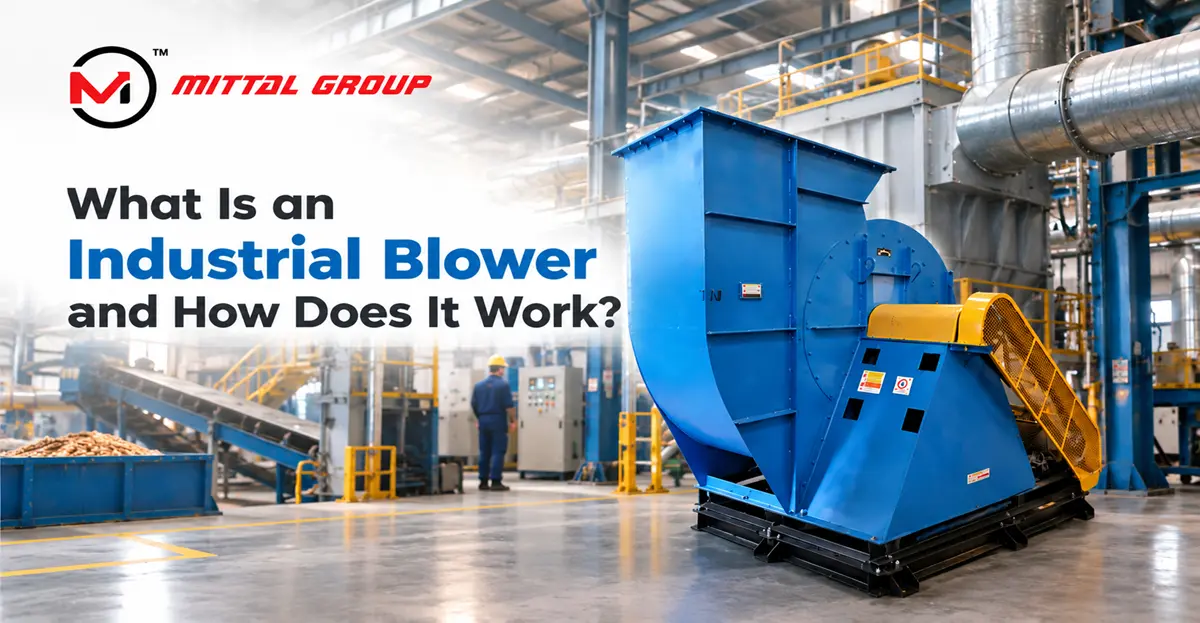
An industrial blower is a machine that moves air or gas at a higher pressure than a standard fan. A motor-driven impeller or rotor draws gas in, adds energy to it, and discharges it against system resistance. Under the ASME PTC 11 classification of dynamic machines, a fan raises pressure up to a specific ratio of 1.11 (roughly 11 kPa at sea-level inlet), a blower covers 1.11 to 1.20 (roughly 11 to 20 kPa), and anything above 1.20 is a compressor. In commercial practice the ranges overlap: positive displacement blowers are routinely rated up to about 100 kPa (1 bar) differential.
Industrial blowers are used for ventilation, dust and fume extraction, drying, cooling, combustion air supply, pneumatic conveying, and wastewater aeration.
Industrial Blower at a Glance
Question | Quick Answer |
What is an industrial blower? | A machine that moves air or gas at raised pressure, typically above what a fan delivers |
How does it work? | A motor turns an impeller or rotor, which passes energy to the gas as velocity and pressure |
Main types | Centrifugal, axial, positive displacement (including Roots), regenerative |
Typical pressure span across types | From under 1 kPa (axial) to about 100 kPa (Roots / multistage) |
Key selection inputs | Flow (m³/h), pressure (Pa or mmWC), gas density and temperature, efficiency, duty cycle |
Biggest hidden cost | Electricity. For continuously running blowers, energy usually outweighs the purchase price over the equipment’s life |
What Are the Main Components of an Industrial Blower?
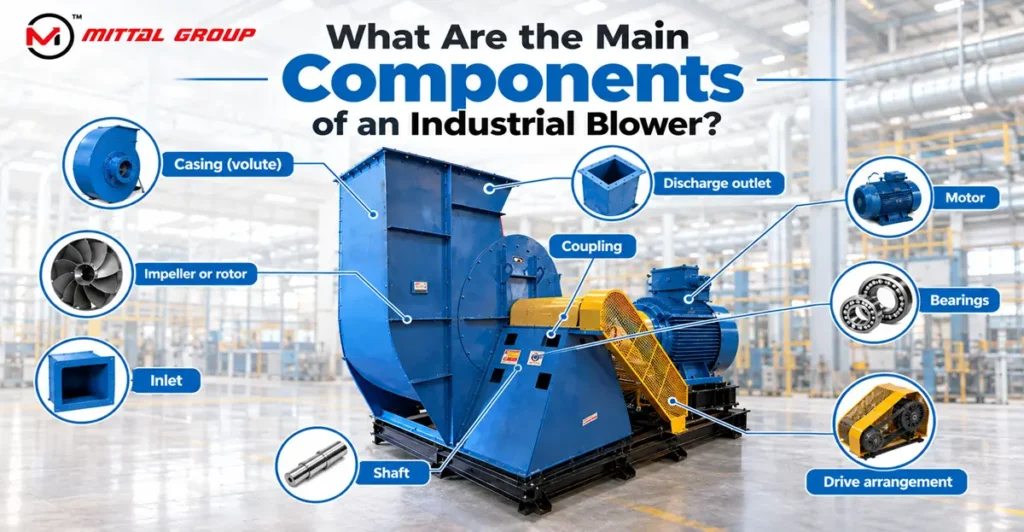
- Impeller or rotor: the rotating part that transfers energy from the motor to the gas. Blade shape (forward-curved, backward-curved, radial, airfoil) strongly affects pressure, efficiency and dust tolerance.
- Casing (volute): encloses the impeller and converts part of the gas velocity into pressure.
- Motor: supplies shaft power. For new installations, look for IE3 or higher efficiency class (IEC 60034-30-1).
- Shaft: transmits torque to the impeller.
- Bearings: support the shaft. Bearing temperature and vibration are the most common early-warning signals of failure.
- Inlet: where gas enters. Poor inlet conditions (sharp bends, obstructions) can reduce delivered performance noticeably.
- Discharge outlet: connects to ducts, pipelines or process equipment.
- Coupling: joins motor and blower shafts and absorbs minor misalignment.
- Drive arrangement: direct drive, belt drive or coupling drive. Belt drives allow speed changes through pulley selection; direct drives have fewer losses and less maintenance.
How Does an Industrial Blower Work?
- Gas enters through the inlet.
- The motor spins the impeller or rotor.
- The rotating element transfers mechanical energy to the gas.
- Gas velocity and/or pressure rises.
- The casing or internal mechanism guides the gas to the discharge.
- Pressurized gas flows into the duct, pipe or process.
Energy flow: Motor power → shaft power → impeller → gas velocity → static pressure → flow into the system.
The Core Calculation
The useful power a blower delivers to the gas (air power) is:
Air power (kW) = Flow (m³/s) × Pressure rise (Pa) ÷ 1000
Shaft power is air power divided by the blower’s total efficiency. This is why efficiency matters: a blower at 60% total efficiency needs about 1.67 kW of shaft power for every 1 kW of air power.
Fan Affinity Laws
For a given blower in the same system, changing the speed (N) changes performance predictably:
- Flow is proportional to N
- Pressure is proportional to N²
- Power is proportional to N³
Example: Reducing speed by 20% (to 0.8×) cuts flow to 80%, pressure to 64%, and power to about 51%. This is the reason variable frequency drives (VFDs) save so much energy on blowers with variable demand.
What Are the Types of Industrial Blowers?
The pressure and efficiency figures below are typical industry ranges. Actual values depend on the manufacturer, size and design, so always confirm against the performance curve of the specific model.
Blower Type | Working Principle | Typical Pressure Range | Typical Total Efficiency | Typical Applications |
Axial | Pushes gas along the shaft axis | Below about 1 kPa (up to a few kPa for high-pressure designs) | 60 to 85% | Cooling, general ventilation, heat removal |
Centrifugal (single stage) | Throws gas outward through an impeller | About 1 to 15 kPa | Forward-curved: 55 to 65%; backward-curved / airfoil: 75 to 85% | Dust collection, fume extraction, process exhaust, combustion air |
Centrifugal (multistage / turbo) | Several impellers in series, or a high-speed single impeller | Roughly 30 to 100 kPa | 65 to 80% | Wastewater aeration, process air |
Roots (lobe) positive displacement | Traps fixed volumes between rotating lobes | Up to about 100 kPa; vacuum to about -50 kPa | 50 to 70% | Pneumatic conveying, aeration, process air |
Regenerative (side channel) | Gas circulates repeatedly through impeller blades | About 5 to 50 kPa; vacuum to about -30 kPa | 20 to 40% | Packaging, vacuum holding, small aeration, material handling |
Centrifugal Blower
Gas enters near the impeller center and is thrown outward. Backward-curved and airfoil impellers are the efficient choice for clean air. Radial-blade impellers cost more in energy but tolerate dust, sticky particles and abrasion, which is why they are common in extraction and material-handling duties.
Axial Blower
Gas moves parallel to the shaft. Axial machines deliver very high airflow at low pressure, which makes them the usual choice for open ventilation and cooling where duct resistance is small. They lose performance quickly as system resistance rises.
Positive Displacement and Roots Blower
These move a nearly fixed volume per revolution, so flow stays almost constant even as pressure changes. That makes them suitable for pneumatic conveying and aeration, where discharge pressure varies with line loading or water depth. They need pressure relief protection, because they will keep building pressure against a blocked line.
Regenerative Blower
Gas passes through the impeller blades many times, building pressure in stages within one revolution. They are compact and oil-free in operation, but their efficiency is low, so they suit small, intermittent duties better than large continuous loads.
Fan vs Blower vs Compressor
Factor | Fan | Industrial Blower | Compressor |
ASME PTC 11 specific ratio | Up to 1.11 | 1.11 to 1.20 | Above 1.20 |
Approx. pressure rise at sea-level inlet | Up to about 11 kPa | About 11 to 20 kPa | Above about 20 kPa |
Typical use | Ventilation, cooling | Process air, extraction, conveying, aeration | Compressed-air and gas systems |
Note: These are classification boundaries for dynamic machines. Manufacturers and industries use the words loosely, and positive displacement “blowers” commonly operate beyond 20 kPa. Select equipment on the actual duty point (flow and pressure), not the name.
Is a blower stronger than a fan? A blower develops more pressure, so it can push through more resistance. But for moving large volumes against almost no resistance, a fan is the better and cheaper machine.
What Are Industrial Blowers Used For?
- Industrial ventilation: removing heat, fumes and contaminated air from production areas.
- Dust and fume extraction: industrial dust transport typically needs duct velocities of around 15 to 25 m/s depending on the dust, and the blower must overcome the combined resistance of hoods, ducts, filters and scrubbers.
- Pneumatic conveying: dilute-phase conveying commonly runs at about 15 to 25 m/s conveying velocity and under about 100 kPa pressure, where Roots blowers are a common choice.
- Combustion air supply: boilers, furnaces and burners need a controlled air flow matched to the fuel input.
- Drying and cooling: moves air across products or equipment to carry away moisture or heat.
- Wastewater aeration: aeration is commonly cited as roughly 45 to 75% of a treatment plant’s total electricity use, which makes blower efficiency the single biggest energy lever in the plant.
- Chemical, food and pharmaceutical processing: process ventilation, drying, cooling and material handling, with materials and construction chosen for corrosion, hygiene and (where flammable atmospheres exist) explosion-protection requirements such as ATEX.
Advantages of Industrial Blowers
- Higher pressure than fans, so they can overcome ducts, filters, diffusers and process resistance.
- Controlled, continuous airflow for long-running processes.
- Wide configuration range: different impeller types, materials, drives and capacities.
- Efficient with the right selection: matching the blower to its duty point, and using a VFD where demand varies, directly reduces energy consumption.
- Process-specific designs for hot gas, corrosive gas, dusty gas or hygienic duties.
Worked Example: Selecting a Blower for a Duty Point
Requirement: 1,000 m³/h of air at 20 °C through a system with a total resistance of 300 mmWC. Assume 60% total blower efficiency.
- Convert flow: 1,000 ÷ 3,600 = 0.278 m³/s.
- Convert pressure: 300 mmWC × 9.81 = about 2,943 Pa (2.9 kPa).
- Air power: 0.278 × 2,943 ÷ 1000 = about 0.82 kW.
- Shaft power: 0.82 ÷ 0.60 = about 1.36 kW.
- Add a 15% margin: about 1.57 kW required. The next standard motor size is 2.2 kW.
If the gas is hot (100 °C instead of 20 °C): Air density drops from about 1.20 kg/m³ to about 0.95 kg/m³. A blower develops pressure in proportion to density, so to deliver 2,943 Pa at 100 °C you must select a blower that produces about 3.7 kPa (about 380 mmWC) at standard conditions. Volume flow stays the same, but check the motor too, because power demand is higher at cold start when the gas is denser.
This one adjustment is among the most common causes of undersized blowers in hot-gas duties.
What Factors Should You Consider When Selecting an Industrial Blower?
- Airflow (m³/h or CFM): from the process, not guesswork. Add leakage allowance for ducted systems.
- Pressure (Pa, mmWC or kPa): the sum of resistance across ducts, pipes, filters, scrubbers, valves, diffusers and equipment, plus a safety margin.
- Gas composition and density: temperature, moisture, altitude and gas type change density, and density changes pressure and power.
- Temperature: standard construction commonly handles gas up to roughly 80 °C. Beyond that you typically need special bearings, shaft cooling, seals and materials. Confirm limits with the manufacturer.
- Dust and particle loading: determines impeller type (radial or paddle for heavy dust, backward-curved for clean air).
- Corrosion and chemical exposure: drives the choice of material (stainless steel, FRP, coated or lined construction).
- Motor and drive: efficiency class (IE3 or better), enclosure rating suitable for the site (for example IP55), and hazardous-area rating if required.
- Efficiency and operating cost: for continuous duty, electricity is usually the largest share of lifetime cost, so compare power consumption at the duty point, not just price.
- Noise: check the sound level at the installation distance against site limits.
- Duty cycle: continuous, intermittent or variable load. Variable loads usually justify a VFD.
Selection Checklist
Required airflow, required pressure, gas composition and density, operating temperature, motor power and efficiency class, speed, material of construction, installation environment, duty cycle, noise limit, efficiency at duty point, maintenance access.
Which Industries Use Industrial Blowers?
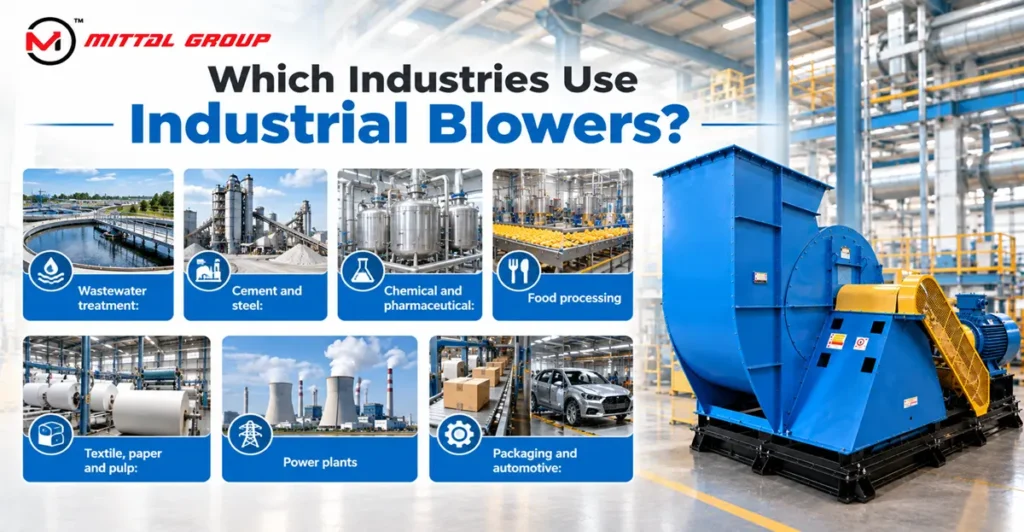
- Wastewater treatment: biological aeration, the largest single energy use in most plants.
- Cement and steel: combustion air, cooling, fume extraction and process exhaust.
- Chemical and pharmaceutical: process ventilation, drying, fume handling, material transfer.
- Food processing: drying, cooling, conveying.
- Textile, paper and pulp: ventilation, drying, dust extraction.
- Power plants: combustion air and cooling.
- Packaging and automotive: vacuum handling, drying, cooling, extraction.
Industrial Blower Maintenance and Safety
Follow the manufacturer’s schedule and adjust for actual operating conditions. Typical checks:
- Bearing temperature, lubrication and condition
- Vibration monitoring (balance quality and vibration limits are covered by ISO 14694 and ISO 10816 / 20816 series)
- Impeller inspection for erosion, buildup and imbalance
- Belt tension and coupling alignment
- Motor current and temperature
- Inlet filter and silencer condition
- Guards and safety devices
- Pressure relief valves on positive displacement blowers
Material buildup on the impeller is a frequent cause of rising vibration in dusty duties. Clean it early, before imbalance damages bearings.
Industrial Blower vs Industrial Fan: Which One Should You Use?
Use a fan when: you need large air volume, resistance is low (typically under about 1 to 2 kPa), and the purpose is general ventilation or cooling.
Use a blower when: resistance is high, the process needs controlled pressure, or the duty involves extraction through filters, pneumatic conveying, aeration or combustion air.
Choose from the duty point on the performance curve, not from the name of the machine.
Standards and References
Performance, testing and quality of industrial blowers and fans are commonly specified against:
- ISO 5801: Fans, performance testing using standardized airways
- AMCA 210 / ISO 5801: laboratory methods for testing fans for aerodynamic performance rating
- ASME PTC 11: Fans, performance test code and classification by specific ratio
- ISO 14694: Fans, specifications for balance quality and vibration levels
- IS 4894: Indian standard for centrifugal fans
- IEC 60034-30-1: Motor efficiency classes (IE codes)
- ATEX Directive 2014/34/EU and ISO 80079 series: equipment for potentially explosive atmospheres
[Add your company’s own test data, product catalog references or case studies here.]
Our Experience
[Insert a real project example from your own work. Include: industry, duty point (flow and pressure), blower type chosen and why, measured result such as energy saved or pressure achieved, and customer name if permitted. This section is the single most valuable addition for AI citation, because it is information no competitor can copy.]