
Centrifugal Blower Material Guide: MS vs SS 304/316 vs FRP for Corrosive Air
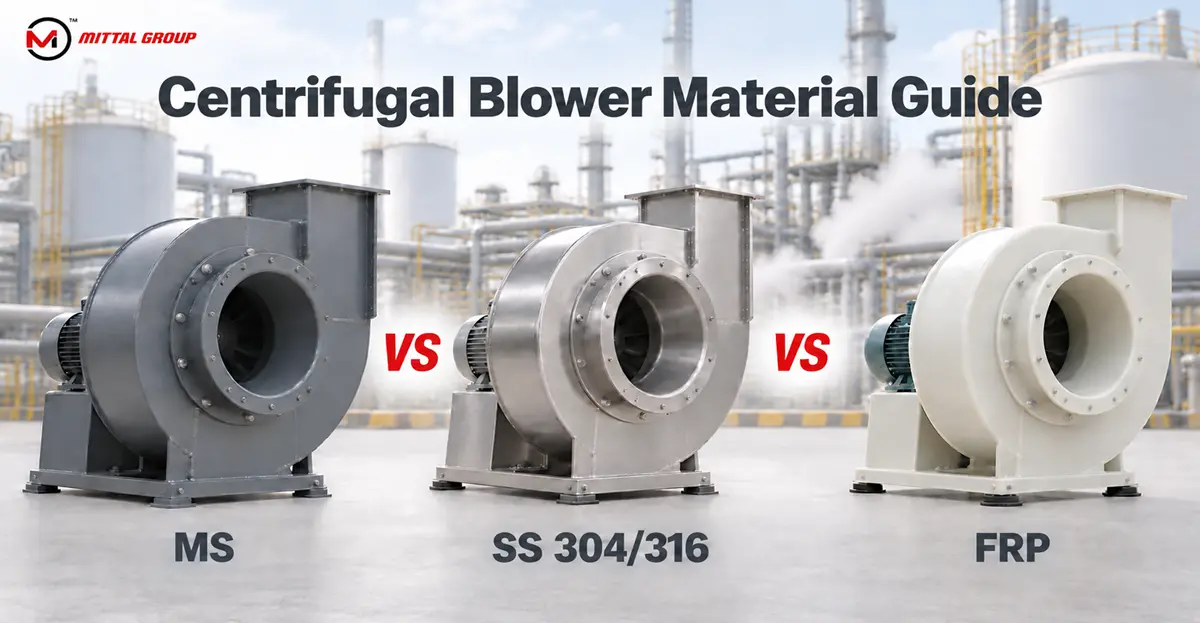
MS (with coating or lining) suits dry, dusty or mildly humid air where no acid is present. SS 304 suits humid, food-grade and mildly corrosive air without chlorides. SS 316 / 316L suits chloride-bearing, pharmaceutical and solvent-laden air. FRP suits strong acid fumes such as hydrochloric and sulphuric acid, as long as the gas stays within its temperature limit and carries little abrasive dust.
A centrifugal blower handling corrosive air rarely fails because it was undersized. It fails because the impeller was made of the wrong material. Acid fumes from a pickling line, chloride-laden mist from a scrubber or humid exhaust from a dyeing unit can eat through an unprotected steel blade in months, and the first sign is usually vibration from an impeller that has lost metal unevenly.
This guide compares the four constructions most often quoted for corrosive duty in Indian plants: mild steel (MS), stainless steel 304, stainless steel 316 and fibre reinforced plastic (FRP). It explains what each material resists, where it fails, which one suits your gas stream and industry, and what to tell a manufacturer so the quotation is built on the right material. It focuses on corrosive gas at normal process temperatures. Hot gas duties are covered in our separate guide on high temperature fan materials.
Why Material Choice Matters More in Corrosive Duty
In a clean-air ventilation blower, material selection is mostly about strength and cost. In corrosive duty, the material decides the life of the machine. Corrosion removes metal from the blades and back plate, and it rarely does so evenly. A blade that thins faster on one side throws the impeller out of balance. That imbalance loads the bearings, raises vibration and eventually cracks welds or shafts, long before the casing itself shows a hole.
Corrosion is also faster inside a blower than in the duct around it. The impeller surface sees high-velocity gas, repeated wetting and drying, and constant stress from rotation. These conditions strip away protective oxide films and paint layers far quicker than in a stationary pipe. So a material that survives well in the ductwork may still be a poor choice for the impeller.
Understand Your Gas Stream Before Choosing a Material
The same material can last fifteen years in one plant and two years in another, because corrosion depends on the exact conditions rather than on the chemical name alone. Dilute acid mist at 40°C behaves very differently from concentrated vapour that condenses on a cold casing during every shutdown.
Before comparing materials, gather the facts below about the air the blower will handle. They matter as much as airflow and static pressure, and a material recommendation without them is only a guess.
Gas stream factors that decide the material
Factor | Why it matters |
Chemical present and concentration | Decides which materials are attacked at all. Hydrochloric acid and chlorine rule out most stainless grades. |
Gas temperature (normal and peak) | Corrosion speeds up with heat, and FRP resins and rubber linings have firm upper limits. |
Moisture and dew point | Most acid gases only become aggressive once moisture condenses on the metal surface. |
Chloride content | Chlorides cause pitting and stress corrosion cracking in stainless steel, especially grade 304. |
Dust load and hardness | Abrasive dust wears away coatings, linings and FRP surfaces, exposing the base material. |
Flammable vapours | Requires spark-resistant construction and, for FRP, an electrically conductive laminate with earthing. |
Indoor or outdoor installation | Outdoor units face UV and rain, which affect paint systems and unprotected FRP. |
Mild Steel (MS) Centrifugal Blowers
Mild steel, usually IS 2062 grade E250 plate, is the default material for industrial centrifugal blowers. It is strong, easy to fabricate and weld, simple to balance and the lowest-cost option. For dust collection, general ventilation and boiler draft duties with dry air, it is often the right choice, and upgrading to stainless steel adds cost without adding life.
Its weakness is corrosion. Bare mild steel rusts in humid air and is attacked quickly by almost every acid. In corrosive duty, MS is only suitable when a protective system separates the steel from the gas. The protection then becomes the real material of construction, and its limits for temperature, abrasion and chemicals set the limits for the whole blower.
Protected MS works well for mildly corrosive duties and tight budgets. It is a poor fit where the lining can be damaged by dust, where the gas is strongly acidic, or where a small breach in the coating would let corrosion spread unseen underneath.
Protection options for mild steel blowers
Protection | Best suited for | Limits |
Epoxy coating | Humid air, mild chemical fumes, indoor units | Chalks in sunlight; damaged easily by abrasive dust |
Epoxy primer with polyurethane topcoat | Outdoor blowers in humid or coastal locations | Surface protection only; not for acid gas contact |
Rubber lining | Wet acidic gas and mist, for example after a wet scrubber | Low temperature limit; restricts impeller tip speed |
Fluoropolymer coating (such as ECTFE or PFA) | Aggressive acids where FRP is not preferred | High cost; needs specialist application and inspection |
Stainless Steel 304 Blowers
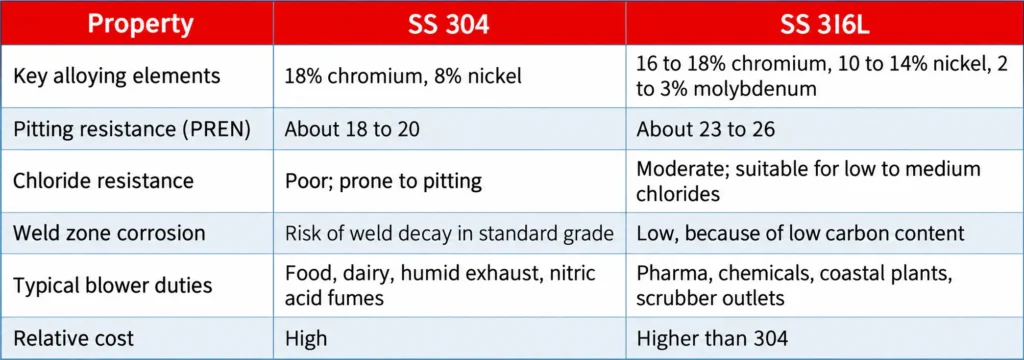
SS 304 contains about 18% chromium and 8% nickel. The chromium forms a thin, self-repairing oxide film that protects the steel from moisture, steam and many mild chemicals. This makes SS 304 the standard choice for humid exhaust, food processing, dairy, bakery and general hygienic air handling, where rust particles cannot be allowed into the product or the room. Our article on centrifugal fans in food processing units covers those duties in more detail.
SS 304 also handles nitric acid fumes and many organic acids well. Its main weakness is chlorides. Salt air, bleach, chlorine, hydrochloric acid and chloride-bearing scrubber mist break down the oxide film at small points, causing pitting. Above roughly 60°C, chlorides can also cause stress corrosion cracking, which appears as fine cracks near welds and in highly stressed areas of the impeller. SS 304 is therefore a good all-rounder only where chlorides are absent.
Stainless Steel 316 and 316L Blowers
SS 316 adds 2 to 3% molybdenum to the 304 chemistry. Molybdenum strengthens the oxide film against chlorides, so SS 316 resists pitting from salt, dilute chlorine and many process chemicals far better than 304. The low-carbon version, 316L, limits carbon to 0.03%, which prevents chromium carbides forming along welds and keeps welded impellers and casings corrosion resistant after fabrication.
These properties make SS 316L the usual choice for pharmaceutical API plants, fine chemicals, solvent recovery, coastal installations and scrubber outlets where the gas carries only traces of acid. It also suits clean-room and process duties that need cleanable surfaces, as explained in our guide to high pressure blowers in pharmaceutical applications. SS 316 is not a cure-all, though. Strong hydrochloric acid, wet chlorine and hot concentrated sulphuric acid still attack it, and those duties usually need FRP or a lined construction.
SS 304 vs SS 316L at a glance
FRP Centrifugal Blowers
FRP blowers are moulded from glass fibre and thermosetting resin. The inner surface that touches the gas is a resin-rich corrosion barrier, usually with a surface veil, backed by a structural laminate that gives the impeller and casing their strength. Because no metal is exposed to the gas, FRP handles hydrochloric acid, dilute sulphuric acid, chlorine, and many salt and acid mixtures that would destroy both MS and stainless steel.
The resin decides what the blower can handle. Isophthalic polyester resin covers mild duties, while vinyl ester resin is the standard for most acid fume extraction. Duties with hydrofluoric acid or strong alkali need a synthetic surface veil instead of glass, because those chemicals attack glass fibre. Where flammable solvent vapour is present, the laminate must include a conductive layer and be earthed, since plain FRP can build up static charge.
FRP has clear limits. Most vinyl ester blowers are rated for continuous gas temperatures of roughly 80 to 90°C, and special resins raise this only modestly. FRP impellers are also less stiff than steel, so they run at lower tip speeds and suit low and medium pressure duties better than high pressure ones. Abrasive dust wears through the corrosion barrier, and outdoor units need a UV-resistant topcoat.
FRP blowers: strengths and limits
Strengths | Limits |
Resists hydrochloric acid, chlorine and most acid mixtures | Continuous temperature limit of roughly 80 to 90°C for vinyl ester resin |
Lightweight, so smaller foundations and bearings | Lower tip speed; not ideal for high pressure duties |
No rust or scale entering the process or stack | Worn quickly by abrasive dust |
Resin can be matched to the chemical | Needs a conductive laminate for flammable vapours |
MS vs SS 304 vs SS 316 vs FRP: Side-by-Side Comparison
Once the gas stream is known, the choice usually narrows to one or two materials. The comparison below puts the main decision factors side by side. Treat it as a starting point for discussion with the manufacturer, not as a final specification, because concentration, temperature and moisture can shift any rating.
Material comparison for corrosive-duty centrifugal blowers
Factor | MS (coated or lined) | SS 304 | SS 316L | FRP (vinyl ester) |
Acid fume resistance | Depends on the lining | Limited | Moderate | Excellent |
Chloride resistance | Depends on the lining | Poor | Moderate | Excellent |
Maximum gas temperature | Set by the coating or lining | High | High | About 80 to 90°C |
Abrasive dust tolerance | Good for the steel; coatings wear | Good | Good | Poor |
Pressure capability | High | High | High | Low to medium |
Hygiene and cleanability | Poor | Very good | Very good | Fair |
Initial cost | Lowest | High | Highest of the metals | Medium to high |
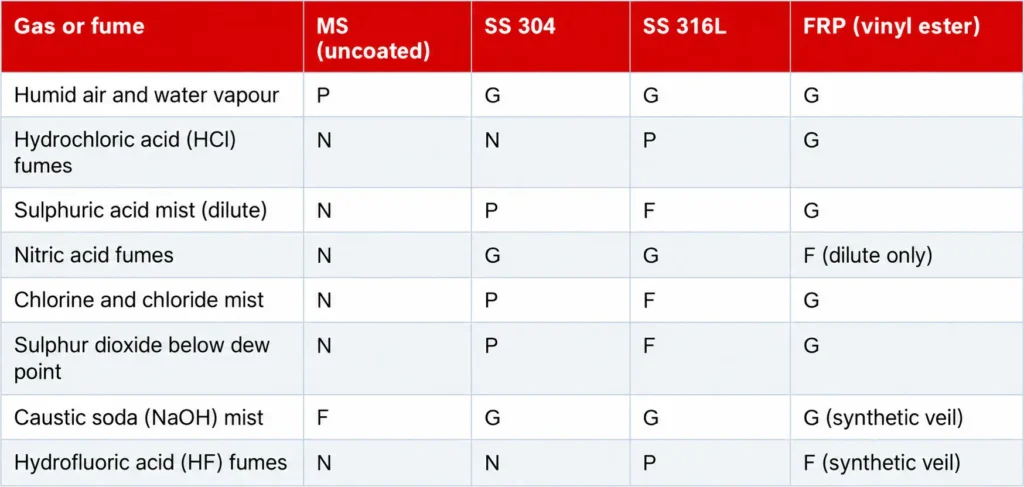
Chemical Compatibility Chart for Blower Materials
The chart below gives an indicative rating for common corrosive gases found in Indian industry. It assumes moist gas at moderate temperature, which is the typical worst case in fume extraction, since dry gas at the same concentration is usually far less aggressive.
Indicative compatibility: G = good, F = fair or conditional, P = poor, N = not recommended
Use this chart with care
Compatibility changes with concentration, temperature and how often the surface stays wet. Always share a gas analysis with the blower manufacturer, and ask for the resin or alloy recommendation in writing before approving the drawing.
Which Material Suits Which Industry?
Specifying an SS 316L or FRP impeller is not enough if the parts around it are left in standard materials. Corrosive gas reaches the shaft where it passes through the casing, the fasteners on the inlet flange, the drain and the inspection door. A rusted shaft seal or a corroded bolt can take the blower out of service as surely as a failed impeller.
The rule is simple: every part that the gas can touch, including through leakage, should be treated as a wetted part and matched to the corrosive duty. Parts outside the gas path, such as the base frame and motor stool, can usually stay in coated MS.
Wetted parts to specify for corrosive duty
Part | What to specify |
Shaft | Stainless steel, or MS with a stainless or FRP sleeve where it passes through the gas |
Shaft seal | PTFE or other chemical-resistant gland to stop gas leaking toward the bearings |
Fasteners in the gas path | Stainless steel, or encapsulated in FRP on FRP blowers |
Gaskets | Chemical-resistant elastomer such as Viton or EPDM, chosen for the specific gas |
Casing drain | Drain point at the lowest point so condensate does not collect |
Flexible connections | Fabric or elastomer compatible with the gas and its temperature |
Use this chart with care
Compatibility changes with concentration, temperature and how often the surface stays wet. Always share a gas analysis with the blower manufacturer, and ask for the resin or alloy recommendation in writing before approving the drawing.
Materials for Parts Beyond the Impeller and Casing
Specifying an SS 316L or FRP impeller is not enough if the parts around it are left in standard materials. Corrosive gas reaches the shaft where it passes through the casing, the fasteners on the inlet flange, the drain and the inspection door. A rusted shaft seal or a corroded bolt can take the blower out of service as surely as a failed impeller.
The rule is simple: every part that the gas can touch, including through leakage, should be treated as a wetted part and matched to the corrosive duty. Parts outside the gas path, such as the base frame and motor stool, can usually stay in coated MS.
Wetted parts to specify for corrosive duty
Part | What to specify |
Shaft | Stainless steel, or MS with a stainless or FRP sleeve where it passes through the gas |
Shaft seal | PTFE or other chemical-resistant gland to stop gas leaking toward the bearings |
Fasteners in the gas path | Stainless steel, or encapsulated in FRP on FRP blowers |
Gaskets | Chemical-resistant elastomer such as Viton or EPDM, chosen for the specific gas |
Casing drain | Drain point at the lowest point so condensate does not collect |
Flexible connections | Fabric or elastomer compatible with the gas and its temperature |
Signs You Are Using the Wrong Blower Material
Material problems usually show up slowly, then suddenly. Operators notice a small rise in vibration or a patch of flaking paint, the blower keeps running, and months later the impeller needs replacing. Catching the early signs gives time to plan a replacement in the right material instead of buying the same one again during an emergency shutdown.
Inspect the impeller and casing interior at every planned shutdown in corrosive duty, and record what you find. A pattern that repeats after each repair usually points to a material mismatch rather than a one-off problem.
- Rising vibration without any change in load, caused by uneven metal loss on the blades.
- Pitting or pinholes on stainless steel surfaces, usually a sign of chloride attack.
- Blistering, flaking or bare patches on coated or lined MS, showing the protection has been breached.
- Exposed glass fibres, cracking or softening on FRP, pointing to chemical attack, heat damage or abrasion.
- Rust-coloured deposits in downstream ducts or the stack, showing metal is being lost inside the blower.
Balancing First Cost Against Service Life
A corrosion-resistant blower always costs more upfront than a standard MS unit, and it is tempting to buy the cheaper option and plan for early replacement. In practice, the purchase price is a small share of what a failed blower costs. Unplanned shutdowns, emergency impeller orders, repeated balancing and lost production normally add up to far more than the price difference between materials.
The most cost-effective choice is the least expensive material that fully resists your gas stream, not the most premium one. Specifying SS 316L for dry dust collection wastes money, while specifying coated MS for hydrochloric acid fumes guarantees an early failure. For a wider view of what drives blower pricing, see our overview of industrial blower prices in India.
Frequently Asked Questions
1. Is an aluminium centrifugal blower suitable for corrosive air?
2. Are polypropylene (PP) blowers a good alternative to FRP?
3. How often should a blower in corrosive service be inspected?
4. Can only the impeller be upgraded to stainless steel while keeping the MS casing?
Looking for an industrial centrifugal blower manufacturer for corrosive duty?
Contact Mittal Blowers with your gas and duty details, or call +91 93135 37327 to discuss the right material for your application.