
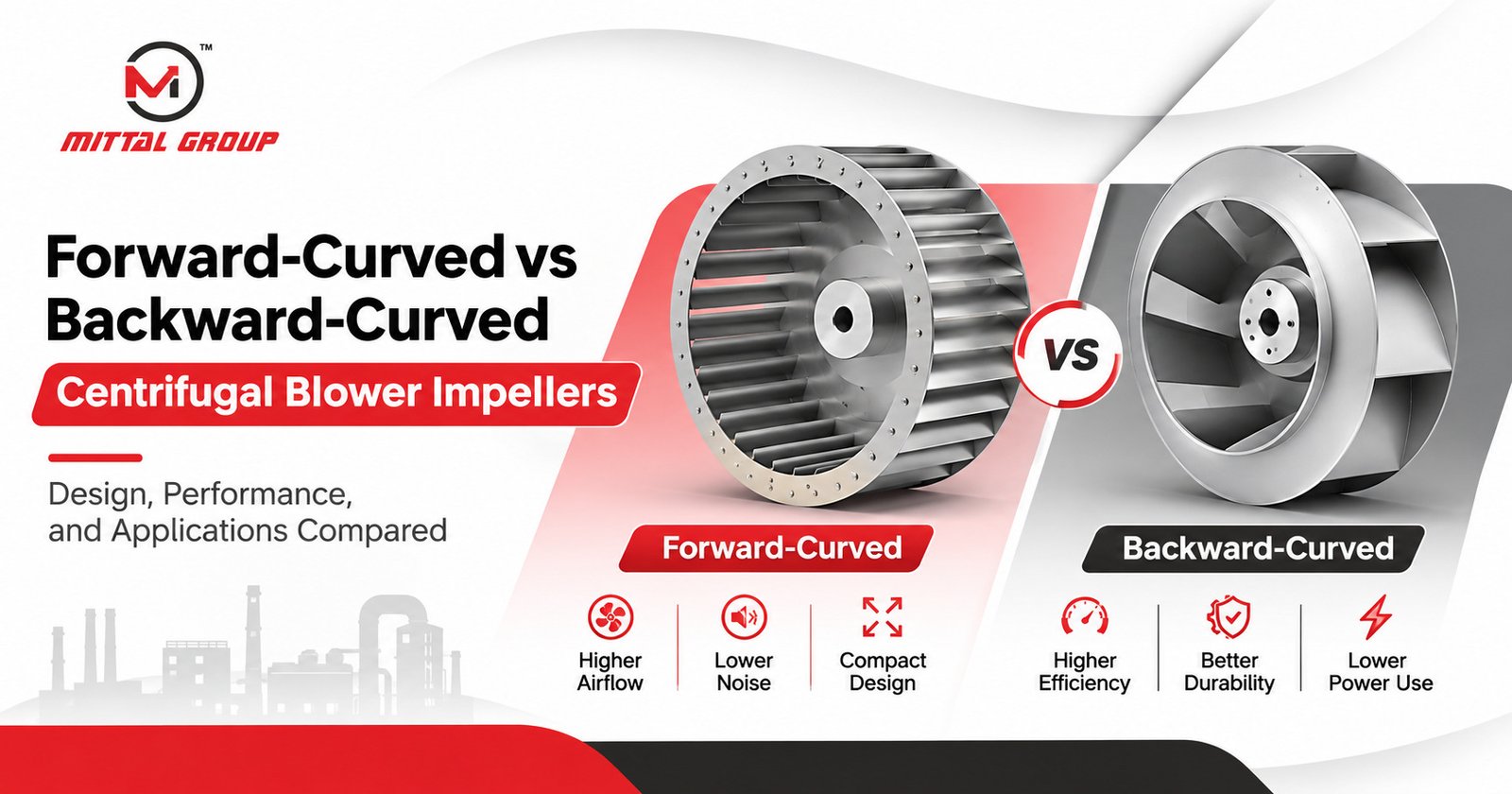
A forward curved centrifugal fan moves a large volume of air at low pressure from a small, slow, quiet wheel, which makes it the usual choice for compact HVAC units. A backward curved centrifugal fan runs faster, reaches higher pressure, is typically 15 to 25 percentage points more efficient, and has a non-overloading power curve, which makes it the better choice for most industrial duties and for any fan that runs long hours.
Introduction to Centrifugal Blower Impellers
The centrifugal blower impeller is the only part of a fan that does work on the air. The housing, inlet cone, shaft and motor all exist to support it. As the wheel spins, air enters at the eye, turns 90 degrees, and is flung outward along the blades into the scroll casing, where its velocity is converted into static pressure.
Because the impeller does all the work, its blade shape decides almost everything a buyer cares about: how much air the fan delivers, how much pressure it builds, how much electricity it draws, how loud it is, and how well it copes with dust or heat. Two fans with the same housing and motor can behave very differently if one has forward curved blades and the other has backward curved blades.
At Mittal Blowers, we have designed and built centrifugal fans in Ahmedabad since 2005, for duties ranging from small ventilation units to large process fans. The question we hear most often at the enquiry stage is simple: "Which impeller do I need?" This guide answers it the way our design team does, by looking at the duty first and the blade second. If you are new to fan construction, our guide to the parts of a centrifugal fan explains how the impeller works with the other components.
Overview of Centrifugal Fan Impeller Types
The types of centrifugal blower impellers are classified by the angle at which each blade leaves the wheel, relative to the direction of rotation. There are four main families:
- Forward curved: blade tips lean in the direction of rotation.
- Backward curved or backward inclined: blade tips lean away from the direction of rotation.
- Airfoil: a backward inclined blade with a hollow, wing-shaped profile.
- Radial: straight blades that point outward from the centre.
Forward Curved Centrifugal Fans
A forward curved centrifugal fan uses many small, shallow, cupped blades, often 24 to 64 of them, set close together around a wide wheel. Because of its appearance, it is often called a "squirrel cage" fan.
The blade tips point forward, so the air leaves the wheel faster than the tip itself is moving. This is why a forward curved wheel can deliver a high volume of air at low pressure while turning slowly, typically at around half the speed of a backward curved wheel doing the same duty. Low speed brings real advantages: a smaller, quieter fan, lighter bearings, and lower first cost.
The trade-offs are significant, though:
- Lower efficiency. Industry references put typical forward curved static efficiency at roughly 50 to 65 percent.
- An overloading power curve. Power draw keeps rising as airflow increases. If system resistance turns out lower than designed, for example when a filter is removed or a damper is left open, the fan moves more air and can overload its motor.
- Pressure limits. Most forward curved fans operate below about 75 mm WC (3 inches of water gauge).
- Poor tolerance of dust. The closely spaced cupped blades trap particulate, which unbalances the wheel.
Best suited to: air handling units, fan coil units, packaged air conditioners, furnaces, clean-air ventilation and other compact, low-pressure duties.
Backward Curved Centrifugal Fans
A backward curved centrifugal fan uses fewer, larger blades, typically 8 to 16, that curve away from the direction of rotation. Air leaves the wheel slower than the blade tip, so the wheel must turn faster to do the same job. In return, it converts energy into pressure far more efficiently.
Key characteristics:
- High efficiency. Typical peak efficiency is about 75 to 86 percent for curved or flat backward blades, and close to 90 percent for airfoil versions, according to published manufacturer data.
- A non-overloading power curve. Power rises to a peak near the best efficiency point and then levels off or falls as flow increases. A motor sized for that peak will not overload at constant speed, even if the system resistance changes.
- Wider pressure range. Backward curved wheels handle low, medium and high pressure duties, up to around 500 mm WC (20 inches of water gauge) in single-stage industrial designs.
- Stable operation. The pressure curve is steep around the operating point, so airflow changes little when system resistance shifts.
- Moderate dust handling. They tolerate lightly dusty air better than forward curved wheels, though heavy particulate still calls for radial blades.
Best suited to: industrial process ventilation, boiler draft, dust collection on the clean side, clean rooms, plug and plenum fans, and large HVAC systems. Our centrifugal plug fans and many of our medium pressure blowers use backward curved impellers for exactly these reasons.
Radial and Airfoil Impellers
For completeness, two related types round out the family:
- Radial impellers have straight blades and self-clean well, so they suit material conveying, heavy dust and high-pressure combustion air. Their efficiency is lower, at roughly 55 to 65 percent.
- Airfoil impellers are the highest-efficiency form of backward inclined wheel, but their hollow blades can erode or fill with dust, so they belong on clean air only.
Key Differences Between Forward and Backward Curved Impellers
The table below summarises the forward curved vs backward curved fan comparison on the points that matter most during selection. Figures are typical ranges from published industry data; actual values depend on the specific design.
| Factor | Forward curved | Backward curved |
|---|---|---|
| Blade count | Many (about 24–64), small and cupped | Few (about 8–16), large |
| Tip direction | Towards rotation | Away from rotation |
| Operating speed | Low | High (roughly twice FC for the same duty) |
| Typical static efficiency | ~50–65% | ~75–86% (airfoil up to ~90%) |
| Pressure capability | Low, usually under ~75 mm WC | Low to high, up to ~500 mm WC |
| Power curve | Overloading | Non-overloading |
| Size for a given duty | Compact | Larger wheel diameter |
| Noise | Low, due to slow speed | Moderate; low when well matched |
| Dust tolerance | Poor | Moderate |
| First cost | Lower | Higher |
| Running cost | Higher | Lower |
| Typical uses | AHUs, FCUs, furnaces, small HVAC | Industrial process, boiler draft, plug fans, large HVAC |
Three differences decide most selections:
- Efficiency and running cost. A 15 to 25 point gap in efficiency translates directly into electricity. For a fan running 6,000 or more hours a year, the backward curved wheel usually recovers its higher purchase price in energy savings well within its working life.
- Motor protection. The overloading curve of a forward curved fan means the motor must be sized for the worst case, or the fan must be protected by controls. The non-overloading curve of a backward curved fan removes that risk.
- Space and noise. When space is tight and pressure is low, a forward curved fan delivers the duty in a smaller, quieter package.
A simple rule of thumb: choose forward curved for compact, low-pressure, clean-air units that run limited hours; choose backward curved for industrial duties, higher pressures, long running hours, or any system where resistance may vary.
Centrifugal Blower Impeller Design Considerations
Good centrifugal blower impeller design starts with the duty, not the catalogue. These are the points our engineers check before recommending a blade type.
Duty point: airflow and static pressure
Every selection begins with the required airflow (in m³/hr or CMH) and the system's static pressure (in mm WC). The impeller should be chosen so that the operating point sits close to its best efficiency point, not at either end of its curve. A fan selected too far to the left of its curve can surge; one selected too far to the right wastes power.
For context, our low pressure blowers cover about 20 to 150 mm WC, medium pressure blowers about 200 to 800 mm WC, and high pressure centrifugal blowers about 600 to 1,800 mm WC. Higher pressure bands almost always point towards backward curved or radial wheels.
Gas condition: dust, moisture and temperature
- Clean air: any type works; efficiency decides.
- Light dust: backward curved, with wear allowance.
- Heavy dust or conveyed material: radial blades.
- Hot gas: blade material, weld design and bearing cooling become critical. Our guide to high temperature industrial fans covers material selection from 200°C to 600°C.
Material of construction
Impellers can be built in mild steel, stainless steel 304 or 316, FRP, or rubber lined steel for corrosive service. Material choice affects weight, safe tip speed and service life. Our centrifugal blower material guide compares MS, SS and FRP for corrosive air.
Tip speed and mechanical strength
Backward curved wheels run at higher speeds, so blade thickness, hub design and weld quality must be sized for the resulting stress. Tip speed, not just RPM, is the figure that governs safe operation.
Balancing and vibration
An unbalanced impeller destroys bearings and foundations. Every wheel should be dynamically balanced to a recognised grade, commonly G6.3 or G2.5 under ISO 21940-11, and checked again after installation.
Inlet and outlet arrangement
The inlet cone clearance, the number of inlets (single or double), and the drive arrangement all influence performance. Double width, double inlet designs such as our DWDI fans roughly double the airflow from a given wheel diameter.
Drive type and speed control
Direct drive simplifies maintenance; belt drive allows speed changes. A variable frequency drive (VFD) is now the most efficient way to adjust airflow, and it pairs especially well with backward curved impellers.
When a standard model does not fit, our customized centrifugal fans and blowers are designed around the exact duty, gas and site layout.
Factors Affecting Centrifugal Fan Efficiency
Centrifugal fan efficiency is the ratio of useful air power delivered to the shaft power absorbed. Blade type sets the ceiling, but the following factors decide how close a real installation gets to it.
1. Impeller blade type
This is the biggest single factor. As shown above, a backward curved or airfoil wheel starts with a significant efficiency advantage over a forward curved one.
2. Operating point on the fan curve
Even the best impeller loses efficiency when it runs far from its best efficiency point. Oversized fans throttled by dampers are one of the most common sources of wasted energy in Indian plants.
3. System effect
Poor duct design near the inlet or outlet, such as a sharp elbow right at the fan, swirl at the inlet or an abrupt transition, can reduce real performance well below the catalogue rating. Allow a straight duct run at the inlet and outlet wherever possible.
4. Clearances and leakage
The gap between the inlet cone and the impeller shroud must be tight and concentric. A large gap lets air recirculate and reduces both pressure and efficiency.
5. Speed control method
The fan laws state that airflow varies with speed, pressure with the square of speed, and power with the cube of speed. Reducing speed by 20 percent cuts power by roughly half. This is why a VFD saves far more energy than an outlet damper.
6. Air density and temperature
Hot or high-altitude air is less dense, so the fan develops less pressure and absorbs less power at the same speed. Selections must be corrected for actual site conditions, not standard air.
7. Build quality and maintenance
Rough blade surfaces, dust build-up, corrosion, misaligned drives and slipping belts all erode efficiency over time.
8. Motor and drive losses
The fan's total system efficiency also includes the motor (an IE3 or IE4 motor is now the sensible baseline) and the drive. Direct drive avoids belt losses of a few percent.
Conclusion
The forward curved vs backward curved fan decision comes down to the duty. A forward curved centrifugal fan is compact, quiet and economical to buy, and it remains the right choice for small, clean, low-pressure HVAC units. A backward curved centrifugal fan costs more up front, but its higher efficiency, wider pressure range and non-overloading power curve make it the better long-term choice for most industrial and high-duty applications.
Whichever you choose, efficiency in service depends as much on correct selection, good ducting, balancing and speed control as on blade shape.
Need help choosing the right impeller? Mittal Blowers designs and manufactures centrifugal fans and blowers in Ahmedabad, with ISO 9001:2015 certification and ZED Gold recognition. Share your airflow, pressure, temperature and gas details with our engineering team for a selection matched to your duty. Request a quote, call +91 93135 37327, or download our catalogue.
Frequently Asked Questions
What is the main difference between forward curved and backward curved impellers?
Forward curved impellers have many small blades that lean towards the direction of rotation. They move high volumes at low pressure and low speed. Backward curved impellers have fewer, larger blades that lean away from rotation. They run faster, build higher pressure, are more efficient and do not overload the motor.
Which centrifugal fan impeller is more efficient?
Backward curved impellers are more efficient, with typical peak efficiency around 75 to 86 percent compared with roughly 50 to 65 percent for forward curved designs. Airfoil versions of the backward inclined wheel can approach 90 percent on clean air.
Why is a backward curved fan called non-overloading?
Its power draw rises to a peak near the best efficiency point and then levels off or falls as airflow increases. A motor sized for that peak cannot be overloaded at constant speed, even if system resistance drops unexpectedly.
Are forward curved fans quieter than backward curved fans?
Usually, yes, for small low-pressure duties, because they deliver the same airflow at lower speed. At higher pressures, a correctly selected backward curved fan running near its best efficiency point can be equally quiet.
Is a backward curved fan more expensive?
The initial price is usually higher because the wheel is larger, heavier and runs faster. For fans that run many hours, the lower power consumption normally offsets that difference over the fan's life.
Which impeller works best with a VFD?
Both can be speed controlled, but backward curved impellers pair best with a VFD. Their stable, non-overloading curve and high efficiency across a wide range give the biggest energy savings.
How do I choose the right centrifugal blower impeller for my plant?
Start with your airflow, static pressure, gas temperature, dust content and running hours. Share these with a fan manufacturer, who can check the selection against actual performance curves rather than a generic rule.