
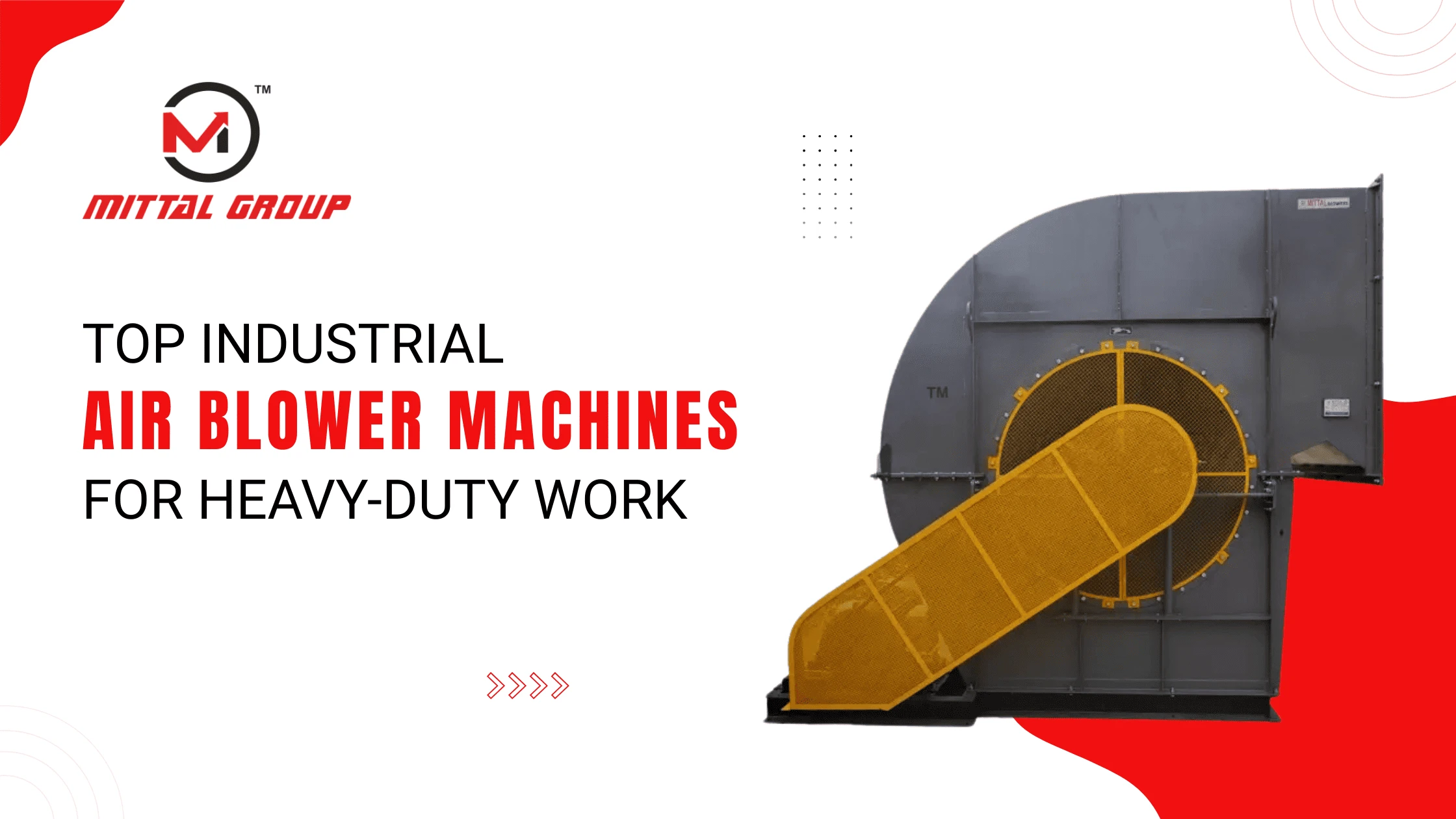
The best industrial air blower for heavy-duty work is the one whose airflow and pressure match your duty point, and whose construction suits your gas temperature, dust and corrosion. For most heavy industrial duties, that means a centrifugal air blower: high pressure for conveying and combustion air, medium pressure for dust and fume extraction, and DWDI or ID fans for very large gas volumes. Positive displacement blowers are typically chosen for high, steady pressure at modest flows.
This guide compares the main industrial blower types for heavy-duty work, explains what each is good at, and shows how to choose and maintain one. It's written for plant engineers, procurement managers and maintenance teams in Indian industry.
What Is an Industrial Air Blower?
An industrial air blower is a machine that moves air or gas at higher pressure than a ventilation fan, for processes such as combustion, drying, conveying, dust extraction and cooling. Most heavy-duty units are centrifugal, using a rotating impeller to throw air outward and raise its pressure inside a scroll-shaped casing.
For a fuller explanation of the basics, see our guide on what an industrial blower is and how it works. This article focuses on heavy-duty selection.
What Makes a Blower "Heavy Duty"?
A heavy duty industrial blower is built to run long hours in demanding conditions without frequent failure. Look for:
- A robust impeller and casing, with plate thickness and welding suited to the speed and the dust load.
- Dynamic balancing of the impeller to a stated balance quality grade.
- Bearings, shafts and drives sized for continuous duty, with cooling where gas is hot.
- Materials matched to the gas: mild steel, stainless steel, abrasion-resistant steel, FRP or rubber lining.
- Accessible construction, with inspection doors and a removable impeller, for maintenance.
- Documented performance: a fan curve showing flow, pressure, power and efficiency.
"Heavy duty" is not a single specification. Ask the supplier how the machine is designed for your temperature, dust and hours.
What Are the Main Industrial Blower Types?
The main industrial blower types are centrifugal (radial, backward-curved and forward-curved impellers), positive displacement (such as twin-lobe Roots blowers), regenerative (side-channel) and multistage or turbo blowers. Centrifugal blowers cover the widest range of heavy industrial duties.
- Centrifugal blowers: an impeller spins inside a volute casing. They are versatile across flow and pressure, and handle dusty and hot gas with the right design.
- Positive displacement (Roots) blowers: rotating lobes trap and push fixed volumes of air. Delivery stays close to constant as pressure varies.
- Regenerative (side-channel) blowers: air is accelerated repeatedly in a ring channel. They are compact and suit low flows at moderate pressure or vacuum.
- Multistage centrifugal and turbo blowers: several impellers, or high-speed designs, for higher pressure at large flows, such as aeration.
Impeller types in a centrifugal air blower
- Radial (paddle) blades: handle heavy dust and material, and resist build-up. Lower efficiency.
- Backward-curved or backward-inclined blades: higher efficiency, with a non-overloading power curve. Suit cleaner or moderately dusty gas.
- Forward-curved blades: high flow in a compact size at low pressure, usually for cleaner air. Power rises with flow.
Our article on parts of a centrifugal fan explains the impeller, casing and drive in more detail.
Top Industrial Air Blower Machines for Heavy-Duty Work
These are the heavy-duty blower types most often used in Indian industry. Where figures are given, they are the ranges Mittal Blowers lists on its product pages. Your exact selection depends on the duty point.
1. High Pressure Industrial Blower
Best for: combustion air, pneumatic conveying, drying, cooling and process air where resistance is high.
A high pressure industrial blower is a centrifugal machine designed to develop high static pressure at moderate flows. Mittal Blowers lists its INTERNAL LINK: high pressure centrifugal blowers at 100–30,000 CMH and 600–1,800 mm WC, with motors up to 150 kW, in mild steel or stainless steel.
Watch for: high tip speeds, so balancing, impeller strength and noise control matter.
2. Medium Pressure Centrifugal Blower
Best for: dust and fume extraction, scrubber and bag filter systems, and process exhaust.
Mittal Blowers lists medium pressure blowers at 300–3,00,000 CMH and 200–800 mm WC, up to 500 kW. Material options include carbon, alloy and stainless steels, Weldox, duplex, FRP and rubber lining. Water-jacketed and bearing-cooled versions are also listed.
Watch for: abrasion and corrosion from dust or fumes, which drive the choice of material and blade type.
3. Low Pressure, High Volume Blower
Best for: general industrial ventilation, cooling, and air movement against low system resistance.
Mittal Blowers lists low pressure blowers at 1,000–3,00,000 CMH, 20–150 mm WC and up to 250 kW.
Watch for: using one where system resistance is higher than expected, which reduces flow.
4. DWDI (Double Width Double Inlet) Fan
Best for: very large air volumes at low pressure, such as HVAC, air handling units, industrial ventilation and fume extraction.
Air enters from both sides of a wide impeller, so a DWDI fan moves large volumes in a compact housing. Mittal Blowers lists its DWDI fans at 1,000–5,00,000 CMH and 50–200 mm WC, up to 250 kW, with direct or V-belt drive.
Watch for: both inlets need clear, even airflow.
5. ID, FD and PA Fans
Best for: boilers, furnaces and thermal power plants.
- ID (induced draft) fans pull flue gas out of the boiler and through pollution control equipment.
- FD (forced draft) fans supply combustion air.
- PA (primary air) fans carry pulverised fuel to the burners.
These are heavy-duty fans that handle hot, dusty gas, and they are selected to the boiler's duty point. See Mittal's ID, FD and PA fans.
Watch for: erosion from fly ash, high temperatures, and the need to control flow across boiler load.
6. Centrifugal Plug Fan
Best for: ovens, dryers, air handling units, clean rooms and heating systems.
A plug fan has no scroll casing; the impeller sits directly in a plenum. Mittal lists plug fans at 1,000–1,50,000 CMH, 20–150 mm WC and gas temperatures up to 300 °C.
Watch for: plenum design, which affects how well the fan performs.
7. Customised Heavy-Duty Blowers
Best for: abrasive, corrosive, hot or unusual gas streams that standard designs don't suit.
Customised centrifugal fans and blowers are engineered around a specific duty, with special materials, linings, cooling or layouts to fit an existing installation.
8. Positive Displacement (Roots) Blower
Best for: steady pressure at relatively low flow, as in wastewater aeration, pneumatic conveying and vacuum duties.
Twin- or tri-lobe blowers deliver nearly constant volume as pressure changes. They need inlet filtration and silencing, and periodic oil and timing-gear maintenance. Mittal Blowers' listed range is centrifugal, so Roots blowers are included here for comparison.
Industrial Blower Types Compared
| Blower type | Airflow (relative) | Pressure (relative) | Typical applications | Advantages | Limitations | Maintenance needs |
|---|---|---|---|---|---|---|
| High pressure centrifugal | Low to medium | High | Combustion air, conveying, drying | High pressure from a single stage; handles some dust | Noise; high tip speed | Balancing, bearings, impeller inspection |
| Medium pressure centrifugal | Medium to very high | Medium | Dust and fume extraction, scrubbers | Versatile; wide material options | Abrasion and corrosion in dirty gas | Wear inspection, cleaning, bearings |
| Low pressure centrifugal | High | Low | Ventilation, cooling | High volume; lower power | Sensitive to system resistance | Belt, bearing and cleaning checks |
| DWDI fan | Very high | Low | HVAC, AHUs, large ventilation | Very large flow in a compact size | Needs clear access to both inlets | Bearings, belts, inlet cleanliness |
| ID/FD/PA fans | High | Medium to high | Boilers, furnaces, power plants | Built for continuous duty with hot or dusty gas | Erosion; needs control across loads | Erosion checks, vibration monitoring, bearing cooling |
| Plug fan | Medium to high | Low | Ovens, dryers, AHUs, clean rooms | Compact; no scroll casing | Depends on plenum design | Impeller cleaning, bearings |
| Positive displacement (Roots) | Low to medium | Medium to high, near-constant flow | Aeration, conveying, vacuum | Stable volume against changing pressure | Noise, pulsation; needs filtration | Oil, timing gears, filters, silencers |
| Regenerative (side-channel) | Low | Medium (pressure or vacuum) | Small conveying, vacuum, aeration | Compact; few wearing parts | Limited flow; sensitive to dirt | Filters, check for blockages |
"Relative" ranges are general guidance. Actual performance depends on the specific design and duty point.
Where Are Industrial Air Blowers Used?
Industrial air blower applications include boiler draft, combustion air, dust and fume extraction, pneumatic conveying, drying and cooling, process air, wastewater aeration and ventilation. The duty point (airflow and pressure) and the gas condition determine which blower type fits each application.
Common industrial air blower applications:
- Power and boilers: ID, FD and PA fans.
- Cement and minerals: kiln, cooler, mill and dust collector fans.
- Steel and foundries: furnace combustion air, fume extraction and cooling.
- Chemicals and pharma: process exhaust, scrubber fans and corrosion-resistant blowers.
- Food processing: drying, cooling and conveying with hygienic materials.
- Textiles and paper: drying, humidification and dust removal.
- Water and wastewater: aeration, usually with positive displacement or multistage blowers.
- General manufacturing: ventilation, cooling and pollution control.
How to Choose the Right Industrial Blower Machine
Start with the duty point: the airflow you need at the static pressure your system creates, at actual gas temperature and density. Then match the blower type, impeller, material, drive and motor to that duty and to the gas conditions.
1. Define the duty point
- Airflow (m³/h or CMH) at actual conditions, not just standard conditions.
- Static pressure (mm WC or Pa), calculated for the full system: ducts, filters, dampers, equipment.
- Margins: a sensible allowance for uncertainty, not a large oversizing that pushes the fan off its efficient zone.
2. Characterise the gas
- Temperature, including upset conditions
- Dust load and type (abrasive, sticky, fibrous)
- Moisture and corrosive content (acids, chlorides, solvents)
- Whether it is flammable or explosive, which needs specific design measures and applicable safety rules
3. Check the fan curve
Ask for the performance curve and confirm the duty point sits near the best-efficiency region. Check the power at that point and whether the power curve rises dangerously at higher flow.
4. Estimate power
A useful first estimate:
Air power (kW) = Airflow (m³/s) × Pressure rise (Pa) ÷ 1,000
Shaft power (kW) = Air power ÷ fan efficiency
The motor is then selected with a margin above shaft power. Use the manufacturer's tested figures for final sizing.
5. Plan for control
The fan affinity laws show why speed control matters. For the same fan and system, flow changes with speed, pressure with speed squared, and power with speed cubed. A variable frequency drive (VFD) can save energy where demand varies. It is usually more efficient than throttling with a damper.
6. Choose materials and construction
Match materials to the gas. Our centrifugal blower material guide compares MS, SS 304/316 and FRP for corrosive air.
7. Ask for documentation
Ask for a GA drawing, the fan curve, balancing records, a test certificate, a bill of materials and the operation and maintenance manual. Ask which test standard the performance is based on. ISO 5801 and AMCA 210 are commonly used, and IS 4894 is the Indian standard for centrifugal fans.
How to Maintain a Heavy Duty Industrial Blower
| Frequency | Checks |
|---|---|
| Daily | Unusual noise, vibration, bearing temperature, motor current |
| Weekly to monthly | Belt tension and wear, coupling alignment, guard condition, leaks at flanges and doors |
| Quarterly or as advised | Bearing lubrication, impeller build-up or wear, damper operation, vibration trend |
| Annual or planned shutdown | Full impeller inspection, rebalancing if needed, casing wear, bearing replacement on condition, motor checks |
Practical tips:
- Trend vibration rather than waiting for failure. Rising vibration usually means imbalance from build-up or wear, misalignment or bearing damage.
- Clean impellers handling sticky or dusty gas on a schedule. Build-up causes imbalance.
- Lock out and tag out before any inspection, and make sure the impeller has stopped and can't windmill.
- Keep spares for critical blowers, such as bearings, belts and seals.
Safety and Noise Considerations
Heavy-duty blowers store a lot of energy in a fast-spinning impeller, so safety is part of selection, not an afterthought:
- Guarding: fit guards on couplings, belts and open inlets, and inlet screens where people or objects could be drawn in.
- Overspeed and imbalance: never run a blower above its rated speed, for example by changing pulleys or VFD settings, without the manufacturer's approval.
- Hot surfaces: insulate or guard casings and ducts that carry hot gas.
- Flammable or explosive gas or dust: use designs and materials suited to the hazard, and follow applicable regulations and site rules.
- Noise: high pressure and high-speed blowers can be loud. Plan for inlet and outlet silencers, acoustic enclosures or lagging, and hearing protection, and ask suppliers for expected sound levels at your duty point.
- Vibration isolation: use correct foundations, anti-vibration mounts and flexible connections, so vibration doesn't travel into ducts and structures.
Common Mistakes When Buying an Industrial Air Blower Machine
- Buying on motor kW alone. Two blowers with the same motor can deliver very different flow and pressure.
- Ignoring system resistance. A blower selected for the wrong pressure won't deliver its rated flow.
- Oversizing "to be safe". This pushes the fan off its efficient zone and wastes power.
- Using standard materials for corrosive or abrasive gas.
- Skipping the fan curve. Without it, you can't check efficiency or the operating point.
Work With Mittal Blowers
Mittal Blowers is an Ahmedabad-based manufacturer of centrifugal fans and blowers, including high, medium and low pressure blowers, DWDI fans, plug fans, ID, FD and PA fans, and customised designs. To select a heavy-duty blower, share your airflow, static pressure, gas temperature, dust and corrosion conditions, and installation layout with the team. They can recommend a type and construction for your duty point.
Conclusion
There's no single "best" industrial air blower for every heavy-duty job. High pressure centrifugal blowers suit combustion and conveying. Medium pressure blowers suit dust and fume extraction. DWDI and low pressure fans move large volumes. ID, FD and PA fans serve boilers, and positive displacement blowers deliver steady pressure. Define your duty point and gas conditions clearly, compare fan curves rather than catalogue claims, and plan maintenance from day one.
FAQ
What is the best industrial air blower for heavy-duty work?
The best blower is the one that matches your duty point (airflow and static pressure) and gas conditions. Centrifugal blowers cover most heavy-duty industrial work. High pressure models suit combustion and conveying, and medium pressure models suit dust and fume extraction.
What is the difference between a fan and an industrial blower?
Both move air. A blower generally develops higher pressure than a ventilation fan, for processes such as combustion, conveying and extraction. In industry, the terms often overlap, and centrifugal "fans" are frequently called blowers.
What are the main types of industrial blowers?
The main types are centrifugal, positive displacement (Roots), regenerative (side-channel), and multistage or turbo blowers. Centrifugal blowers are further grouped by impeller type: radial, backward-curved and forward-curved.
What is a high pressure industrial blower used for?
High pressure blowers are used where system resistance is high, such as combustion air, pneumatic conveying, drying and some process air duties. Mittal Blowers lists its high pressure range at 600–1,800 mm WC.
How do I choose the right blower size?
Calculate the airflow you need at actual temperature, and the total static pressure of your system. Then compare manufacturers' fan curves to find a blower that runs near its best-efficiency point at that duty.
Which blower is best for dust extraction?
Medium pressure centrifugal blowers are commonly used for dust and fume extraction. Radial or wear-resistant impellers suit heavy or abrasive dust, and corrosion-resistant materials suit fumes.
How can I reduce a blower's energy use?
Select a blower that operates near its best-efficiency point, avoid oversizing, reduce system resistance, and use a variable frequency drive where demand varies. Keep impellers clean and belts correctly tensioned.
How often should an industrial blower be serviced?
Check noise, vibration and bearing temperature daily. Inspect belts and alignment monthly, and lubricate bearings as the manufacturer advises. Carry out a full inspection at planned shutdowns, at least once a year for continuous-duty blowers.