
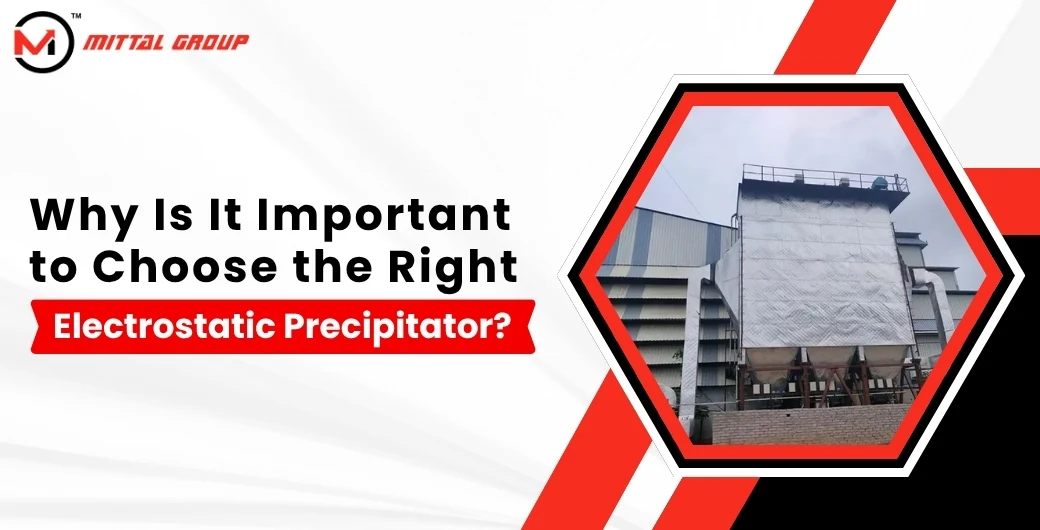
Choosing the right electrostatic precipitator matters because ESP performance depends on matching the design to the gas flow, temperature, dust properties and emission limits of a specific process. A well-matched ESP collects fine dust efficiently at low pressure drop. A poorly matched one can miss emission limits, break down more often and cost more to run.
An electrostatic precipitator (ESP) is one of the most effective ways to remove fine dust from industrial exhaust gas. It is also a large, long-term investment that is difficult to change once installed. Two ESPs that look similar on paper can perform very differently on the same process, because performance depends on details such as dust resistivity, gas distribution and collection area.
This guide explains how ESPs work, the main types and applications, what controls efficiency, and the selection criteria that technical buyers and plant engineers should check before committing to a design.
What Is an Electrostatic Precipitator?
An electrostatic precipitator (ESP) is an air pollution control device that removes fine dust and particles from a gas stream using electrical charge. Particles are charged by high-voltage electrodes, pulled onto oppositely charged collecting plates, and then removed into hoppers. ESPs are widely used on boilers, kilns and furnaces that handle large gas volumes.
An industrial electrostatic precipitator usually has these main parts:
- Discharge electrodes: wires, rigid frames or spiked electrodes energised at high negative DC voltage.
- Collecting electrodes: large earthed plates or tubes where dust collects.
- Transformer-rectifier (TR) sets: supply and control the high voltage for each field.
- Rapping or washing system: dislodges collected dust (dry ESP) or flushes it away (wet ESP).
- Hoppers and dust discharge: collect and remove dust from the bottom.
- Gas distribution screens: spread the flow evenly across the ESP.
- Casing, insulators and controls.
How Does an Electrostatic Precipitator Work?
The electrostatic precipitator working principle has four steps: high voltage creates a corona around the discharge electrodes; gas ions charge passing dust particles; the electric field pushes charged particles to the collecting plates; and rapping or washing moves the collected dust into hoppers for removal.
Step 1: Corona generation
The discharge electrodes are energised at a high DC voltage. Near the electrode the electric field is strong enough to ionise the gas, forming a corona.
Step 2: Particle charging
Gas ions from the corona attach to dust particles as they pass, giving them an electrical charge.
Step 3: Migration and collection
The electric field drives charged particles sideways towards the earthed collecting plates, where they build up as a dust layer.
Step 4: Dust removal
In a dry ESP, mechanical rappers periodically strike the plates so the dust layer falls into the hoppers. In a wet ESP, a water film or spray washes the plates continuously or at intervals.
The Deutsch–Anderson equation
ESP design is often first estimated with the Deutsch–Anderson relationship:
Efficiency (η) = 1 − exp(−w × A / Q)
where w is the effective particle migration velocity, A is the total collecting plate area and Q is the gas flow rate. The ratio A/Q is the specific collection area (SCA). The equation shows why a higher gas flow, or dust that migrates slowly, needs more plate area for the same efficiency. Real designs rely on test data and vendor experience, since migration velocity depends strongly on the dust and gas.
What Are the Main Electrostatic Precipitator Types?
The main electrostatic precipitator types are dry and wet ESPs. By geometry, they are plate–wire (plate-type), tubular (wire–pipe) and two-stage designs. Dry plate-type ESPs dominate large boilers and kilns, while wet and tubular ESPs suit moist, sticky or acid-mist gases.
Dry ESP
Dust is collected dry and removed by rapping. It suits hot, dry gases such as boiler flue gas, cement kiln exhaust and sinter plant gas.
Wet ESP
Plates are kept wet and the collected material is washed off. It is used for sticky particles, acid mists, tars and saturated gases, often after a scrubber.
Plate–wire (plate-type) ESP
Discharge electrodes hang between parallel collecting plates, in several fields in series. It is the most common design for large gas volumes.
Tubular (wire–pipe) ESP
Each discharge electrode runs down the centre of a tube. It is typically used for smaller flows and in wet ESP designs.
Two-stage ESP
Charging and collection happen in separate sections. It is used for light dust and oil mist in smaller, cleaner gas streams.
Comparison of electrostatic precipitator types
| Type | Dust removal | Best suited to | Typical limitations |
|---|---|---|---|
| Dry plate–wire ESP | Rapping into hoppers | Large flows of hot, dry gas: boilers, kilns, sinter plants | Sensitive to dust resistivity; large footprint |
| Wet ESP | Water washing | Sticky particles, acid mist, saturated gas | Water treatment and corrosion-resistant materials needed |
| Tubular (wire–pipe) ESP | Washing or rapping | Smaller flows, mists, wet applications | Lower capacity per unit than plate-type |
| Two-stage ESP | Washing or manual cleaning | Light loads, oil mist, cleaner gases | Not suited to heavy dust loads |
Where Are Electrostatic Precipitators Used?
Electrostatic precipitator applications are concentrated in industries with high gas volumes and fine dust, such as thermal power, cement, iron and steel, pulp and paper, non-ferrous metals and waste incineration. ESPs are chosen where a low pressure drop and high efficiency on fine particles matter.
Common applications include:
- Thermal power plants: fly ash removal from coal-fired boilers, the largest single use. The US EPA reports that about 80% of ESPs in the US serve the electric utility industry.
- Cement plants: kiln exhaust, clinker coolers and raw and coal mills.
- Iron and steel: sinter plants, blast furnace gas cleaning and steelmaking.
- Pulp and paper: recovery boilers, which EPA lists among the main ESP users.
- Non-ferrous metals: copper, zinc and aluminium smelting.
- Industrial and biomass boilers: in sugar, textile, chemical and food plants.
- Waste incineration and sulphuric acid plants (wet ESPs for acid mist).
In India, power plants, cement, and iron and steel are among CPCB's 17 categories of highly polluting industries. Under CPCB's 2017 guidelines, they must install continuous emission monitoring systems (CEMS) for particulate matter, with data sent to the State Pollution Control Board and CPCB. That makes stable, consistent ESP performance a compliance issue, not just an engineering one.
What Affects Electrostatic Precipitator Efficiency?
Electrostatic precipitator efficiency depends mainly on dust resistivity, particle size, gas flow and velocity, gas temperature and moisture, collecting area and the number of fields, gas distribution, and electrode and rapping condition. EPA reports design efficiencies of 99–99.9% for new ESPs and 90–99.9% for older units.
Key factors:
- Dust resistivity. EPA's fact sheet gives an ideal range of about 5 × 10³ to 2 × 10¹⁰ ohm-cm. Very high resistivity causes back corona, which cuts efficiency; fly ash from low-sulphur coal is a known example. Very low resistivity lets dust slip off the plates and re-enter the gas.
- Particle size. Particles of about 0.1–1.0 µm are the hardest to collect.
- Gas flow and velocity. Flow above the design value reduces the time particles spend in the field and lowers the SCA.
- Temperature and moisture. Both change resistivity. Gas conditioning can help where resistivity is too high.
- Gas distribution. Uneven flow across the inlet overloads some areas while others are underused.
- Electrode and rapping condition. Broken wires, misaligned plates, build-up or poor rapping all reduce performance.
- Power supply and controls. Well-tuned TR set controls keep voltage high without excessive sparking.
- Air in-leakage through doors, hoppers and ducting cools the gas and adds volume.
What Are the Electrostatic Precipitator Selection Criteria?
Key electrostatic precipitator selection criteria are gas volume, temperature and composition, dust load, particle size and resistivity, the emission limit to be met, available space, power supply, ID fan capacity, maintenance access and lifecycle cost. Base the decision on measured process data, not catalogue figures.
Check these before you choose:
- Gas flow rate: design, maximum and future flows, at actual temperature.
- Gas temperature and moisture: normal and upset conditions, and the dew point.
- Dust load at the inlet (g/Nm³) and the required outlet concentration.
- Particle size distribution and resistivity: test samples where possible.
- Gas composition: SO₂, SO₃, acid mists, combustibles and sticky substances, which affect material choice and whether a dry or wet ESP is suitable.
- Emission limit: the applicable CPCB/SPCB standard for your industry, plus your consent conditions and a design margin.
- Number of fields and SCA: enough collecting area for the worst expected dust.
- Space and layout: footprint, duct routing and access for maintenance.
- Power supply and controls: TR set rating, and whether automatic voltage control is included.
- Pressure drop and fan matching: the whole gas path, not just the ESP.
- Maintenance access: inspection doors, walkways, rapping and spare parts.
- Lifecycle cost: capital cost, power, maintenance, downtime and expected service life.
- Supplier track record: references in your industry and similar dust.
Don't overlook the ID fan
An ESP has a low pressure drop of its own: EPA gives a typical figure of under 13 mm of water column for wire-plate ESPs. But it sits in a gas path with ducts, dampers and other equipment, and the induced draft (ID) fan moves the whole gas volume through it. If the fan is undersized, the plant loses draft. If it's oversized or poorly controlled, gas velocity through the ESP can rise and efficiency falls. A properly selected ID fan, sized for actual gas volume, temperature, dust and system resistance, is part of choosing the right ESP system.
For dusty or corrosive flue gas, fan material and construction matter too. See our entrifugal blower material guide for MS, stainless steel and FRP options.
What Are the Electrostatic Precipitator Advantages?
Electrostatic precipitator advantages include high collection efficiency on fine particles, a very low pressure drop, the ability to handle large gas volumes and high temperatures, and dry dust collection for reuse or disposal. The trade-offs are high capital cost, a large footprint and sensitivity to dust properties.
Advantages:
- High efficiency, including on fine particles (99–99.9% for new designs, per EPA).
- Low pressure drop, which keeps fan power, and therefore operating cost, low.
- Handles large gas volumes: EPA cites 100–500 m³/s for wire-plate units.
- Wide temperature range: EPA gives up to about 700 °C for wire-plate ESPs.
- Dry collection, so dust such as fly ash can often be reused.
- Long service life with good maintenance.
Limitations to plan for:
- High capital cost and a large footprint.
- Sensitivity to changes in gas flow, temperature and dust properties.
- Not suited to sticky or moist dust in dry designs.
- Explosion risk with combustible gases or dust, which needs specific design measures.
- Wire electrodes and rappers need regular maintenance.
Common Mistakes When Choosing an ESP
- Sizing for average conditions only. Design for peak flow, high dust load and upset conditions such as boiler start-up and fuel changes.
- Skipping a dust resistivity test. Fuel or raw material changes, such as low-sulphur coal or alternative fuels in a kiln, can move resistivity out of the ideal range.
- Comparing quotations on price alone. Check the collecting area, number of fields, TR set rating and the guaranteed outlet emission on each bid.
- Ignoring the fan and ducting. Poor gas distribution and a mismatched ID fan reduce the performance of a well-designed ESP.
- Under-planning maintenance access. Without safe access to electrodes, rappers and hoppers, small faults turn into major outages.
Why Choosing the Right ESP Matters
A wrong choice usually shows up in one of five ways:
- Compliance risk: emissions drift above the limit when dust or load changes, and CEMS readings show it.
- Energy waste: fans work harder to compensate for poor duct or fan matching.
- Unplanned downtime: wire breakage, hopper bridging and corrosion from a poor material choice.
- Costly retrofits: adding fields, conditioning systems or replacement ESPs later.
- Lost production: boilers or kilns throttled back to stay within limits.
Plan the Whole System
Mittal Blowers, based in Ahmedabad, Gujarat, manufactures ID, FD and PA fans and a range of centrifugal fans and blowers for manufacturing, environmental and processing industries. When you're planning a new ESP or upgrading an existing one, share your gas volume, temperature, dust load and system resistance with your ESP supplier and fan manufacturer together, so the fan and precipitator are designed as one system. To understand how fans move air and gas in these systems, see what an industrial blower is and how it works.
Frequently Asked Questions
What is an electrostatic precipitator used for?
An electrostatic precipitator removes dust, fly ash and fine particles from industrial exhaust gases using electrical charge. It is common in thermal power plants, cement kilns, steel plants, pulp and paper mills and incinerators.
How efficient is an electrostatic precipitator?
The US EPA reports design efficiencies of 99–99.9% for new ESPs, and 90–99.9% for older units in operation. Actual performance depends on dust resistivity, particle size, gas flow and maintenance.
What is the difference between a dry and a wet ESP?
A dry ESP collects dust as a dry layer and removes it by rapping. A wet ESP keeps the plates wet and washes the collected material away. That suits sticky particles, acid mists and saturated gases.
Is an ESP better than a bag filter?
Neither is better in every case. ESPs have a low pressure drop and handle high temperatures and very large gas volumes well. Bag filters are less sensitive to dust resistivity, but have a higher pressure drop and temperature limits set by the filter fabric. The choice depends on your dust, gas and emission target.
What is dust resistivity, and why does it matter?
Resistivity is how strongly the dust resists electrical current. Very high resistivity causes back corona and lower efficiency. Very low resistivity lets dust re-enter the gas. EPA gives an ideal range of about 5 × 10³ to 2 × 10¹⁰ ohm-cm.
How does the ID fan affect ESP performance?
The ID fan pulls gas through the ESP. An undersized fan loses draft, while excessive flow raises gas velocity through the ESP and lowers efficiency. The fan should be sized for actual gas volume, temperature and system resistance.
Do Indian industries need to monitor ESP emissions continuously?
CPCB guidelines require the 17 categories of highly polluting industries, including power, cement, and iron and steel, to install continuous emission monitoring for particulate matter, with data sent to the SPCB and CPCB.
How often should an ESP be maintained?
Follow the supplier's schedule. Typically, operators check controls and hoppers daily, review rapping and electrical readings regularly, and carry out internal inspections during planned shutdowns.